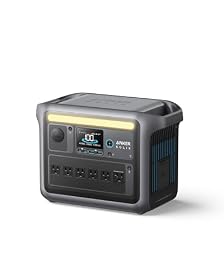
Best Power Station for Camping: How to Choose the Right Size
The best power station for camping depends on what you need to run and for how long. Use this guide to match watt-hours, inverter output, portability, and charging options to your campsite.
Best power station for camping
The best power station for camping is large enough to run your essential devices without being unnecessarily heavy. For short trips with phones, lights, and cameras, a compact unit is usually enough. Longer stays, CPAP machines, electric coolers, cooking appliances, or refrigeration require more battery capacity and a stronger inverter.
Start by listing the devices you will use, their wattage, and the number of hours they need to run. Then choose a power station with extra capacity for charging losses, cold weather, and unexpected use.
Quick recommendations by camping style
Phone charging, lights, cameras, and small electronics: Look for a compact power station with roughly 200–500 watt-hours (Wh) of capacity.
Weekend camping with laptops, a cooler, fans, or a CPAP: A mid-size unit in the roughly 500–1,000Wh range is often more practical.
Extended trips or several AC-powered devices: Consider 1,000Wh or more, provided you can transport and recharge it conveniently.
Electric cooking or high-wattage appliances: Prioritize inverter output first. A large battery is not useful if the inverter cannot start and run the appliance.
Off-grid or remote camping: Choose a model that supports solar charging and has enough solar input to recover meaningful energy during daylight.
These are starting points rather than guarantees. Actual runtime depends on device wattage, power-conversion losses, temperature, and how often each device is used.
How to size a power station for camping
Calculate energy use in watt-hours
Watt-hours estimate how much energy a device uses over time:
Watts × hours of use = watt-hours
For example, a 10W light used for five hours consumes about 50Wh. A 60W laptop used for four hours consumes about 240Wh. Add the devices together, then allow a reserve rather than planning to drain the battery completely.
Power stations lose some energy while converting battery power to AC power, and the rated battery capacity is not always fully available at the outlets. A practical target is to choose more capacity than your basic calculation requires—often around 20% to 30% extra for ordinary camping loads.
Check running watts and starting watts
The inverter must support the device's continuous or running wattage. Some appliances also require a brief surge of higher power when their motors start. This matters for refrigerators, portable freezers, pumps, compressors, and some power tools.
If an appliance lists both running and starting watts, compare both with the power station's continuous and surge ratings. Do not assume that a high battery capacity automatically means high output. Capacity and inverter strength are separate specifications.
Account for 12-volt devices
A 12V cooler, air pump, or other vehicle-style accessory may be more efficient through a regulated DC output than through a wall-style AC outlet. If you plan to use these devices, check the power station's available DC ports, output limits, and connector type.
Product prices and availability are accurate as of the date/time indicated and are subject to change. Any price and availability information displayed on Amazon.com at the time of purchase will apply to the purchase of this product.
The most important specifications
Battery capacity
Capacity is listed in watt-hours. More Wh generally means longer runtime, but it also usually means more weight and a higher transport burden.
For car camping, a larger unit may be worthwhile because you can move it from the vehicle to camp in fewer trips. For backpacking or locations without vehicle access, weight and physical size may matter more than maximum capacity.
Inverter output
The inverter converts the battery's DC power into AC power for household-style plugs. Compare the continuous output with the devices you intend to run, and check the surge specification for motor-driven equipment.
A pure sine wave inverter is generally preferable for sensitive electronics and devices with motors. Follow the device manufacturer's requirements if a particular appliance specifies the type of AC power it needs.
Battery chemistry and cycle life
Many current power stations use lithium iron phosphate, commonly called LiFePO4, batteries. This chemistry is often selected for its durability and thermal characteristics, but the specific cycle-life rating, charging limits, and warranty vary by product.
Do not compare cycle counts without checking how the manufacturer defines a cycle and the capacity remaining at the end of that rating. Keep the unit within the stated temperature and charging limits.
Charging options
For camping, useful charging methods include:
AC charging: Usually the fastest and most predictable option before leaving home.
Solar charging: Helpful at remote campsites, but actual output changes with sun angle, shade, temperature, panel orientation, and the station's solar-input limit.
Vehicle charging: Convenient while driving, though often slower than AC charging.
USB-C charging: Useful for small electronics and, on some models, for recharging the power station itself.
Check whether the solar panel voltage and connector are compatible with the station. Do not connect panels in a configuration that exceeds the station's maximum voltage or current. Use the manufacturer's instructions for panel wiring and adapters.
Ports and controls
Before buying, count the ports you will use at the same time. Important details include the number of AC outlets, USB-A and USB-C ports, 12V outputs, wireless controls, display readability, and whether outlets can be switched on independently.
A clear display should show remaining capacity, input wattage, output wattage, and warnings. An app can be helpful for monitoring a station inside a tent or vehicle, but it should not replace a readable onboard display.
Product prices and availability are accurate as of the date/time indicated and are subject to change. Any price and availability information displayed on Amazon.com at the time of purchase will apply to the purchase of this product.
Features that matter at a campsite
Weight and carrying design
A power station may be easy to carry from a car but inconvenient to move around a large campground. Check the listed weight and handle design, not just the battery capacity. Larger units may have wheels or multiple handles; smaller units may be easier to place on a table or inside a tent vestibule.
Low-power performance
Some stations have a power-saving mode that shuts off outputs when the load is very low. This can save energy, but it may interrupt devices that draw power intermittently, such as some chargers, routers, or medical equipment. Look for adjustable settings or disable the feature when continuous operation is important.
Noise and ventilation
Fans may run during charging or when the inverter is under load. A power station should have clear airflow around its vents. Do not cover it with clothing or bedding, and do not operate it in a sealed tent, vehicle cabin, or other poorly ventilated space unless the manufacturer specifically permits that use.
Weather protection
Most portable power stations are not automatically waterproof. Keep the unit dry, protect it from rain and condensation, and check the manual for temperature and outdoor-use limits. Solar panels may be designed for outdoor use while the power station itself still requires shelter.
Product prices and availability are accurate as of the date/time indicated and are subject to change. Any price and availability information displayed on Amazon.com at the time of purchase will apply to the purchase of this product.
Matching a power station to common camping devices
Phones and cameras: Capacity is rarely the main challenge; USB ports and recharge speed are more important.
LED lights: Low-wattage lighting can run for a long time, but several lights used overnight still add up.
Laptop: Check the laptop charger's wattage and consider using USB-C if the station supports the required charging standard.
CPAP: Confirm whether the manufacturer supports DC operation or battery use. Heated humidification can substantially increase energy demand.
Electric cooler or portable refrigerator: Look at average energy use, not only compressor startup wattage. Temperature, insulation, and ambient heat affect runtime.
Electric blanket or fan: These may be moderate loads that run for many hours, so calculate total Wh carefully.
Coffee maker, hot plate, or kettle: These can draw high wattage and quickly deplete a battery. Check inverter output and expected runtime before relying on one at camp.
Product prices and availability are accurate as of the date/time indicated and are subject to change. Any price and availability information displayed on Amazon.com at the time of purchase will apply to the purchase of this product.
When solar charging is worth paying for
Solar input is most useful when you will spend multiple days away from outlets and have reliable access to direct sunlight. It is less valuable for a one-night trip where you can fully charge at home beforehand.
Compare the station's maximum solar-input rating with the panel array you plan to use. A larger panel array does not necessarily produce more power if the station limits incoming voltage or current. Shade can reduce output sharply, so solar should usually be treated as a recharge option rather than a guarantee of continuous power.
Safety and campsite setup
Read the power station and connected-device manuals before use.
Keep the unit dry and away from standing water.
Leave clearance around cooling vents.
Do not connect incompatible solar panels, cables, or adapters.
Avoid charging or discharging outside the stated temperature range.
Do not use a power station to backfeed a home's electrical system through a wall outlet. Home backup connections require equipment and installation appropriate for that purpose.
Stop using the unit if it is damaged, unusually hot, swollen, leaking, smoking, or producing a burning odor. Move away from it if safe to do so and follow the manufacturer's instructions or contact a qualified professional.
Common buying mistakes
Buying by watt-hours alone
A large battery may still be unsuitable if the inverter cannot handle your appliance's running or startup demand. Check both capacity and output.
Choosing a unit that is too heavy
A power station that stays in the vehicle because it is difficult to carry may be less useful than a smaller model you can position near the campsite.
Ignoring recharge time
A station with a large battery can take substantial time to recharge from a vehicle or modest solar panel. Check AC, car, and solar charging times separately.
Assuming every port works at full output simultaneously
Manufacturers may specify shared limits for groups of ports. Review the output table and simultaneous-use restrictions before planning several devices at once.
When to choose a different solution
A portable power station is a good fit when you want quiet, rechargeable power without gasoline. It may not be the right choice for heavy continuous loads, whole-home backup, or appliances that must run for many days without a reliable recharge source.
For occasional phone charging, a smaller battery bank may be lighter and less expensive. For a refrigerator during a prolonged outage, calculate the refrigerator's energy use over 24 hours and plan a recharge method rather than relying only on the station's advertised capacity.
The best camping power station is the one that meets your actual wattage and runtime needs, can be recharged with the resources available at your campsite, and is light enough for you to handle safely.
FAQ
What size power station do I need for camping?
For phones, lights, and cameras, a compact unit around 200–500Wh may be enough. Weekend trips with a laptop, cooler, CPAP, or fan often call for roughly 500–1,000Wh. Choose based on calculated watt-hours and add reserve capacity rather than relying on battery size alone.
Can a power station run a camping refrigerator?
Often, yes, but you must check both the refrigerator's running and startup requirements and the station's inverter ratings. Runtime also depends on ambient temperature, insulation, thermostat settings, and how often the compressor runs.
Is LiFePO4 better for a camping power station?
LiFePO4 batteries are commonly chosen for durability and thermal characteristics, but the exact cycle-life rating, warranty, charging limits, and capacity vary. Compare the complete battery specifications rather than chemistry alone.
Can I charge a power station with solar panels while camping?
Usually, if the panel voltage, current, connector, and total wattage fall within the station's solar-input limits. Shade and weather can greatly reduce output, so solar charging should not be treated as a guaranteed full-power source.
Can I use a portable power station inside a tent?
Follow the manufacturer's instructions and keep ventilation clear. Do not cover the station or operate it where heat cannot escape. Keep it dry, and do not use gasoline-powered generators inside or near enclosed camping areas.