A mini fridge often uses roughly 500–1,000 watt-hours (Wh) per day, but the actual amount depends on its size, efficiency, room temperature, and how often it is opened. For a reliable estimate, check the fridge’s energy label or measure its consumption; then allow extra power for conversion losses and the compressor’s startup surge when choosing a portable power station.
Wh & Watts · Sun Sep 13
How many watt-hours a mini fridge uses
Many mini fridges use roughly 500–1,000 Wh per day, but the exact amount depends on the model and conditions. Here’s how to calculate your fridge’s use and choose a power station that can handle it.
Quick estimate
If the fridge has an EnergyGuide label, use its estimated annual energy consumption in kilowatt-hours (kWh):
Daily Wh = annual kWh × 1,000 ÷ 365
For example, a fridge labeled at 300 kWh per year averages about 822 Wh per day (300 × 1,000 ÷ 365). That is an average: the fridge does not necessarily draw power continuously at the same rate.
If there is no annual energy figure, the wattage printed on the fridge can help you estimate energy use, but it is not enough by itself to predict a full day’s consumption. A compressor cycles on and off, so multiply its running watts by the hours it actually runs—not automatically by 24.
Extend runtime with solar charging
 Anker 521 Portable Power Station Upgraded with LiFePO4 Battery, 256Wh 6-Port Powerhouse, 300W (Peak 600W)…Anker
$229.99 as of
View on Amazon Renogy 100W Portable Solar Panel, 25% High Efficiency Solar Panel Kit with 20A Charger Controller…Renogy
$206.99 as of
View on Amazon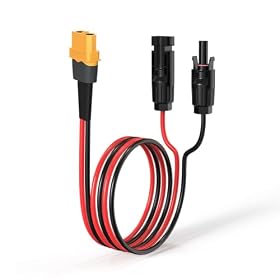 ELFCULB 10AWG 6FT XT60 Solar Cable 2 6 10 25 35 50 75 100FT XT60…ELFCULB
$18.88 as of
View on Amazon
Product prices and availability are accurate as of the date/time indicated and are subject to change. Any price and availability information displayed on Amazon.com at the time of purchase will apply to the purchase of this product.
Get a more accurate measurement
A plug-in energy meter can show the fridge’s accumulated kWh over a day or several days. Use one only if it is rated for the appliance and outlet, and follow its instructions. Measuring over a longer period can smooth out differences caused by room temperature and door openings.
For a simple estimate from a meter reading:
- Daily Wh = measured kWh × 1,000 ÷ number of days
- Estimated use for an outage = daily Wh × outage days
Keep the fridge in a normally ventilated location during measurement. A hot room, frequent door openings, or poor airflow around the appliance can increase energy use.
Convert fridge use into power station capacity
A power station’s capacity is listed in watt-hours, but not all of that stored energy reaches an AC appliance. The inverter that supplies household-style AC power uses some energy, and the actual loss varies by unit and load.
Use this formula as a planning estimate:
Power station capacity needed = fridge Wh for the outage ÷ estimated AC efficiency
For example, if the fridge uses 822 Wh per day and you assume 85% AC efficiency for planning, one day’s estimate is about 967 Wh of station capacity (822 ÷ 0.85). The 85% figure is an example assumption, not a guarantee; check the power station’s specifications and leave a margin if the outage may last longer or conditions are uncertain.
Also check the station’s continuous AC output and surge rating. The continuous rating must support the fridge while it runs, and the surge rating must accommodate compressor startup. Compare those ratings with the fridge’s label or manual. If the startup requirement is not listed, ask the appliance or power-station manufacturer rather than guessing.
What changes a mini fridge’s watt-hour use?
- Size and efficiency: Larger or less efficient models generally need more energy.
- Room temperature and airflow: Heat and blocked ventilation can make the compressor run more often.
- Door openings and contents: Frequent openings and warm items add to the cooling load.
- Thermostat setting: A colder setting can increase consumption.
- Age and condition: Worn seals or a poorly maintained appliance may use more energy.
For outage planning, use a measured reading when possible. If you only have an estimate, size the power station with extra capacity rather than assuming the fridge will use the lowest figure in a broad range.
FAQ
How many watt-hours does a mini fridge use per day?
A useful rough planning range is about 500–1,000 Wh per day, though some models and conditions fall outside it. Use the fridge’s annual kWh label or measure its energy use for a more accurate figure.
Can I calculate daily energy use from the mini fridge’s wattage?
Only if you know how long it actually draws that wattage. A compressor cycles on and off, so multiplying its running watts by 24 hours can overestimate daily use. An energy label or plug-in energy meter is more useful.
What size power station will run a mini fridge for one day?
Estimate the fridge’s daily Wh, then divide by the power station’s AC efficiency to account for inverter losses. Also confirm that the station’s continuous output and surge rating meet the fridge’s requirements.
Will a mini fridge run from a power station’s USB port?
Usually, a household mini fridge needs an AC outlet, but check the fridge’s plug and specifications. If it requires AC, the station must have a suitable AC outlet and enough continuous and surge output.