A power station can run a fridge if it has enough usable watt-hours for the length of the outage and an inverter that can handle the compressor’s startup surge. Check your refrigerator’s actual energy use if possible; its size or running-watt label alone won’t tell you how long a power station will run it.
Wh & Watts · Tue Sep 15
What Size Power Station for a Fridge?
Choose a power station by matching its usable watt-hours to your fridge’s energy use over the time you need backup, then confirm its inverter can handle compressor startup.
Calculate the energy capacity you need
First estimate how much energy the fridge uses each day, in watt-hours (Wh). Then multiply by the number of backup days and account for power lost when the station converts battery power to AC.
Power station capacity needed ≈ fridge energy use per day × backup days ÷ 0.85
The 0.85 factor is a rough planning allowance for conversion losses. Actual usable capacity varies by power station, temperature, and operating conditions, so check the manufacturer’s specifications and leave extra margin when you can.
For example, if a fridge uses 1,200 Wh per day, a 24-hour backup would call for about 1,400 Wh of rated battery capacity using that allowance. For 48 hours, the estimate is about 2,800 Wh. These are examples, not a guarantee: real runtime depends on the fridge and conditions.
Find the fridge’s daily energy use
Use the most reliable information available, in this order:
- Measure it with a plug-in energy meter. If the fridge plugs into a standard household outlet, a compatible meter can record its energy use over a full day or longer. A longer reading captures compressor cycling better than a brief measurement.
- Check the EnergyGuide label or manual. If annual energy use is listed in kilowatt-hours (kWh), divide by 365 to estimate average daily use, then multiply by 1,000 to convert kWh to Wh. For example, 365 kWh per year averages 1 kWh (1,000 Wh) per day.
- Use a rough estimate only when necessary. Many full-size refrigerators use around 1–2 kWh per day, but actual use can fall outside that range. Age, size, temperature settings, room heat, door openings, and condition all matter.
A fridge’s running watts are not the same as its daily energy use. The compressor switches on and off, so a refrigerator may draw power for only part of the day.
Add capacity for longer fridge runtime
 Compatible with Anker Portable Power Station Expansion AdapterGeneric
$25.50 as of
View on Amazon Compatible with Anker Portable Power Station Expansion Adapter, blackksuayw
$25.00 as of
View on Amazon Compatible with Anker Portable Power Station Expansion Adapter, whiteksuayw
$25.00 as of
View on Amazon
Product prices and availability are accurate as of the date/time indicated and are subject to change. Any price and availability information displayed on Amazon.com at the time of purchase will apply to the purchase of this product.
Check inverter power and startup surge
Watt-hours describe how much energy the battery stores. Watts describe how much power the station can deliver at once. Your power station needs both enough capacity for the desired runtime and an AC inverter that can start and run the refrigerator.
Refrigerator compressors can briefly draw more power when starting than they use while running. Check the fridge manual or rating label for starting requirements, and compare them with the power station’s continuous output and surge or peak output. Don’t rely on a station’s peak rating as if it were continuous. If the fridge’s startup requirement is unclear, ask the refrigerator or power-station manufacturer whether the models are compatible.
Recharge a station during an outage
 Renogy 100W Portable Solar Panel, 25% High Efficiency Solar Panel Kit with 20A Charger Controller…Renogy
$206.99 as of
View on Amazon Anker 521 Portable Power Station Upgraded with LiFePO4 Battery, 256Wh 6-Port Powerhouse, 300W (Peak 600W)…Anker
$229.99 as of
View on Amazon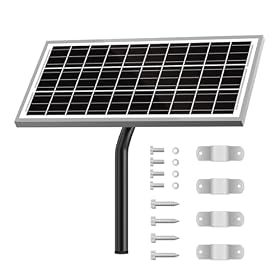 Newpowa 15W 12V 10BB Solar Panel Automatic Gate Openers, Compatible with Mighty Mule, Powered Charger…Newpowa
$54.99 as of
View on Amazon
Product prices and availability are accurate as of the date/time indicated and are subject to change. Any price and availability information displayed on Amazon.com at the time of purchase will apply to the purchase of this product.
Choose a size based on your backup plan
- Short outage or overnight: Estimate energy use for the hours you need, rather than assuming a full day. A station around 1,000–1,500 Wh may be a starting point for some fridges, but it may not last overnight in every setup.
- About one day: Use the fridge’s measured or estimated daily Wh, divide by the station’s usable fraction, and add a margin. A 1,200 Wh-per-day fridge, for instance, would need roughly 1,400 Wh of rated capacity for one day using the 0.85 planning factor.
- Two or more days: Multiply daily use by the number of days. A larger station, compatible expansion battery, or a way to recharge the station may be needed. Solar or vehicle charging can help replenish energy, but the amount depends on charging input, weather, and available time.
If you can’t measure the fridge, choose a larger capacity than a bare estimate suggests. Hot weather, frequent door openings, and starting with a warm fridge can increase energy use. Keeping the door closed helps conserve both food temperature and battery.
If the power station won’t run the fridge
- Check the station’s display and settings. Confirm its AC output is on, the battery has charge, and the outlet is enabled.
- Confirm the connection and operating mode. Plug the fridge directly into the station unless the manufacturers specify another arrangement. Follow both manuals; some stations have output limits or modes that affect AC operation.
- Check the fridge’s startup demand. If the station shuts off when the compressor starts, its inverter may not support the surge. Don’t repeatedly force restarts; check manufacturer guidance or use a station with suitable output.
- Check the station’s capacity. If it runs initially but stops after a few hours, the battery may simply be too small for the fridge’s energy use.
- Stop if there is heat, damage, or unusual noise. Disconnect the equipment and contact the manufacturer or a qualified technician if you suspect an electrical fault.
Use the power station as directed, keep it dry and ventilated, and never connect it to household wiring or a wall outlet to power a home unless the system is specifically designed and installed for that purpose. If you need longer runtime, a compatible expansion battery or a larger station is a reasonable next step; confirm compatibility before buying.
FAQ
How many watt-hours does a power station need to run a refrigerator?
It depends on the fridge’s daily energy use and how long you need backup. Estimate: daily fridge watt-hours × backup days ÷ about 0.85. The 0.85 factor is only a planning allowance; check the station’s usable capacity and leave a margin.
Can a 1,000-watt power station run a refrigerator?
Possibly, but 1,000 watts describes power output, not battery capacity. Check that the inverter can handle the fridge’s running load and startup surge, and check the station’s watt-hour capacity to estimate runtime.
Will a power station run a fridge overnight?
It may, if its usable capacity covers the fridge’s energy use for those hours and its inverter handles compressor startup. A full-day energy measurement gives a better estimate than the fridge’s running-watt rating.
Can I recharge a power station with solar while it runs a fridge?
Some stations support simultaneous charging and AC output, but not all. Check the manufacturer’s specifications, including solar input limits and operating guidance. Solar production varies with sunlight, weather, panel placement, and season.