A portable power station is a good fit for quiet, limited backup, but it may not be the right foundation for keeping selected home circuits running through a long outage. If you need sustained power for high-demand equipment, want to use existing household wiring, or can safely store and manage fuel, a generator paired with a properly installed transfer switch may be the more practical choice.
Comparisons · Mon Sep 21
When a Transfer Switch and Generator Are the Real Plan
A portable power station can cover quiet, limited backup needs. For longer outages, high-demand appliances, or selected home circuits, a generator and transfer switch may be the more practical plan.
When a generator and transfer switch make more sense
Consider this setup when your outage plan needs to cover more than a few low-power devices:
- Long outages: A generator can keep supplying power as long as it has fuel and is maintained. A battery station has a finite stored capacity; recharging it may depend on available wall power, solar conditions, or a vehicle.
- High or sustained loads: Equipment such as a well pump, larger heating or cooling equipment, or multiple household appliances can exceed a power station’s output or drain its battery quickly. Check each appliance’s running and startup requirements before choosing any backup source.
- Selected household circuits: A transfer switch can route generator power to designated circuits, so you can operate chosen lights, outlets, or appliances through the home’s wiring. The circuits and the generator must be sized for the intended loads.
- Fuel-based backup is acceptable: A generator requires fuel, outdoor operation, maintenance, and safe storage. If those are realistic for your home, it can be a better fit for repeated or extended outages.
A generator does not automatically power an entire house. The generator’s rated output, the transfer equipment, and the loads you run together determine what is available.
Portable power station for limited home backup
 Ecarke 550W Portable Power Inverter Compatible with Makita 18V Battery, DC 18V to AC 110V…Ecarke
$94.99 as of
View on Amazon
Product prices and availability are accurate as of the date/time indicated and are subject to change. Any price and availability information displayed on Amazon.com at the time of purchase will apply to the purchase of this product.
When a portable power station is still the better fit
A portable power station can be preferable when you need quiet power for phones, networking equipment, lights, or a modest refrigerator load; want to use it indoors according to its instructions; or do not want to handle generator fuel and engine maintenance. It can also be useful for camping or as a smaller backup layer even when a generator covers larger home loads.
Compare the station’s continuous output in watts with the appliances you plan to run, and check whether it can handle their startup surge. Its capacity in watt-hours (Wh) helps estimate how long it can supply a load: divide usable capacity by the average watts drawn for a rough estimate. Real runtime varies with the appliance’s duty cycle, conversion losses, temperature, and the station’s operating limits.
For a refrigerator, do not rely only on its average energy use: compressors can draw more power when starting. Check the appliance and power-station manuals, and leave room for other loads if you plan to run them at the same time.
Solar recharging for a portable power station
 Renogy 100W Portable Solar Panel, 25% High Efficiency Solar Panel Kit with 20A Charger Controller…Renogy
$206.99 as of
View on Amazon Anker 521 Portable Power Station Upgraded with LiFePO4 Battery, 256Wh 6-Port Powerhouse, 300W (Peak 600W)…Anker
$229.99 as of
View on Amazon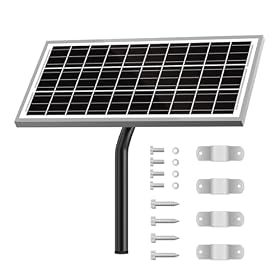 Newpowa 15W 12V 10BB Solar Panel Automatic Gate Openers, Compatible with Mighty Mule, Powered Charger…Newpowa
$54.99 as of
View on Amazon
Product prices and availability are accurate as of the date/time indicated and are subject to change. Any price and availability information displayed on Amazon.com at the time of purchase will apply to the purchase of this product.
Compare the practical tradeoffs
| Factor | Generator with transfer switch | Portable power station |
|---|---|---|
| Energy supply | Continues while fuel is available and the unit is operating | Limited by stored energy and available recharging |
| Household connection | Can feed selected circuits through compatible transfer equipment | Usually powers devices from its own outlets; home-circuit connection requires specifically compatible equipment and professional guidance |
| Noise and emissions | Engine noise and exhaust; outdoor placement is essential | Quiet operation with no exhaust while discharging |
| Upkeep | Fuel management, engine maintenance, and periodic checks | Battery care and charging; no engine fuel system |
| Best suited to | Longer outages and selected larger household loads, if properly sized | Quiet, smaller loads and portable use |
The right choice depends on the loads you need to protect, how long you may be without utility power, and whether you can operate and maintain a generator safely. Some households use both: a generator for selected circuits and a power station for quiet or portable backup.
Plan a transfer-switch setup safely
Have a licensed electrician determine whether a transfer switch or another approved transfer device is suitable, which circuits it should serve, and what generator capacity is needed. The electrician can also check equipment compatibility and applicable electrical requirements.
Never connect a generator to a home by plugging it into a wall outlet or using an improvised connection. That can send power back onto utility lines and create a serious hazard. Use only an approved transfer arrangement installed and operated as directed. Run a fuel generator outdoors, away from doors, windows, and air intakes, following the manufacturer’s instructions and local requirements to reduce carbon-monoxide risk.
Do not assume a portable power station can connect to a generator transfer switch just because it has an AC outlet. Output, neutral-ground configuration, grounding, and transfer equipment must be compatible. Ask the equipment manufacturers and a qualified electrician before connecting a station to household wiring.
Make the decision with a load list
Write down the appliances and circuits you need during an outage, including their running watts and any startup surge. Decide which loads can take turns rather than run together. Then compare the generator’s usable output and the transfer switch’s supported arrangement against that plan. For a power station, compare continuous and surge output, usable capacity, and realistic recharge options.
If the essential loads exceed a station’s output or require more energy than you can reliably recharge, a professionally planned generator-and-transfer-switch setup is likely the better primary backup. If your needs are modest and quiet operation matters most, a portable power station may be enough.
FAQ
Can a portable power station use a home transfer switch?
Sometimes, but only when the station and transfer equipment are specifically compatible and the connection is set up correctly. Output limits and neutral-ground configuration can matter. Confirm compatibility with the manufacturers and a qualified electrician; do not improvise a connection.
Is a transfer switch necessary to run a generator during an outage?
A transfer switch is one approved way to connect a generator to selected household circuits. The essential rule is to use a properly approved transfer arrangement and never backfeed a home through an outlet. Ask a licensed electrician which setup is appropriate.
Which is better for keeping a refrigerator running during an outage?
Either may work if it can handle the refrigerator’s startup demand and provide enough energy. A power station is quiet but has finite capacity; a generator can keep running while fuel is available. Check the refrigerator’s requirements and the backup unit’s specifications.