The panel’s open-circuit voltage, or Voc, must stay below the portable power station’s maximum solar-input voltage. Check the panel’s Voc under the coldest conditions you expect, not just the number printed on the panel, because solar-panel voltage rises in cold weather. Also confirm the station’s minimum and maximum input voltage, maximum current, and maximum solar wattage before connecting the panel.
Solar · Mon Sep 07
Matching open-circuit voltage of panels to the station
Match a panel’s cold-weather open-circuit voltage to the power station’s solar-input range before connecting anything. This guide explains Voc, series and parallel wiring, current limits, and the checks that prevent an overvoltage error or damage.
What open-circuit voltage means
Voc is the voltage a solar panel produces when it is exposed to light but is not connected to a load. It is normally listed on the panel’s label or specification sheet.
Voc is different from:
- Vmp: Voltage at the panel’s maximum power point while producing power
- Imp: Current at the maximum power point
- Isc: Short-circuit current
- Rated wattage: The panel’s approximate maximum output under specified test conditions
For matching purposes, Voc is the critical overvoltage check. A station’s solar-input specification may be shown as a range, such as a minimum-to-maximum voltage, along with a maximum current and wattage. The panel or array must fit within all of those limits.
A panel can have a suitable wattage and still be unsafe if its Voc is too high. Conversely, a panel with a safe voltage may produce little or no useful charging if its operating voltage is below the station’s minimum input voltage.
Compatible solar panel for a portable power station
 Renogy 100W Portable Solar Panel, 25% High Efficiency Solar Panel Kit with 20A Charger Controller…Renogy
$229.30 as of
View on Amazon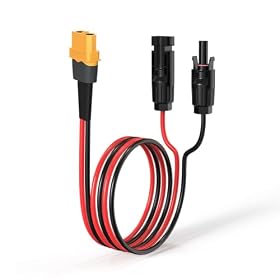 ELFCULB 10AWG 6FT XT60 Solar Cable 2 6 10 25 35 50 75 100FT XT60…ELFCULB
$18.88 as of
View on Amazon ELFCULB 10AWG 35FT XT60 Solar Cable 2 10 25 35 50 75 100FT XT60 Extension…ELFCULB
$58.88 as of
View on Amazon
Product prices and availability are accurate as of the date/time indicated and are subject to change. Any price and availability information displayed on Amazon.com at the time of purchase will apply to the purchase of this product.
How to compare the panel with the station
Find these specifications in the manuals or on the manufacturer’s product pages:
- Station solar-input voltage range
- Maximum solar-input voltage
- Maximum solar-input current
- Maximum solar-input wattage
- Required connector or adapter
- Whether the input accepts the panel type you plan to use
Then check the panel’s:
- Voc
- Vmp
- Isc
- Imp
- Rated wattage
- Temperature coefficient for voltage, if provided
The basic check is:
Adjusted array Voc must be below the station’s maximum solar-input voltage, while the panel’s operating voltage should fall within the station’s accepted input range.
Do not treat the station’s maximum wattage as permission to exceed its voltage or current limits. Voltage, current, and wattage are separate constraints.
Solar extension cable for a portable power station
 YDDECW Solar Panel Extension Cable - 100FT Solar Wire 10AWG+14AWG PV Wire Female & Male…YDDECW
$79.99 as of
View on Amazon UCANUUP 30FT Solar Extension Cable for Jackery SolarSaga & ExplorerUCANUUP
$26.99 as of
View on Amazon Jackery DC Extension Flat Cable Plus for Solar Panel 32.8 feet / 10 MeterJackery
$59.00 as of
View on Amazon
Product prices and availability are accurate as of the date/time indicated and are subject to change. Any price and availability information displayed on Amazon.com at the time of purchase will apply to the purchase of this product.
Why cold weather matters
Solar-panel Voc generally increases as temperature falls. The Voc printed on the panel is usually measured under a standard test condition, not necessarily the coldest temperature at your campsite or home.
For a conservative estimate, use the panel manufacturer’s voltage temperature coefficient. A simplified calculation is:
Cold-adjusted Voc ≈ rated Voc × [1 + voltage increase caused by the temperature difference]
The exact calculation depends on how the coefficient is expressed. Some manufacturers list it as a percentage per degree Celsius; others provide a voltage value per degree. Follow the manufacturer’s formula when available.
If the panel will be used in freezing weather, leave a safety margin below the station’s maximum input voltage. A panel that appears barely within the limit at standard conditions may exceed it on a bright, cold morning.
Series and parallel wiring change the match
The number of panels and the wiring arrangement determine the array’s voltage and current.
Panels in series
In a series connection:
- Voltages add together
- Current is approximately limited by the panel with the lowest relevant current rating
- The combined Voc can become too high quickly
For example, connecting two identical panels in series roughly doubles their Voc. Use the cold-adjusted combined Voc for the maximum-voltage check.
Array Voc in series ≈ Panel 1 Voc + Panel 2 Voc
Never connect panels in series merely because the total wattage is within the station’s wattage limit. The combined voltage must also remain below the station’s maximum.
Panels in parallel
In a parallel connection:
- Voltage remains approximately the same as one panel
- Current adds together
- The combined current must remain within the station’s input-current limit
For example, two identical panels in parallel may provide roughly twice the current of one panel at about the same voltage. If the array can produce more current than the station accepts, the station may limit the input, reject the connection, or require a different configuration. Follow the station manufacturer’s instructions rather than assuming excess current is harmless.
A simple matching example
Suppose a station manual specifies a solar-input voltage range with a stated maximum, and a panel label lists a particular Voc. The panel is potentially suitable only if:
- Its cold-adjusted Voc remains below the station’s maximum voltage
- Its operating voltage is high enough to enter the station’s input range
- Its Imp or Isc does not exceed the station’s current limit
- Its rated wattage does not exceed the station’s allowed solar-input wattage
- The connector polarity and adapter are correct
If two panels are placed in series, add their cold-adjusted Voc values. If they are placed in parallel, add their current values instead. These are illustrative rules, not a substitute for the specifications of the exact panel and station.
Common matching mistakes
Using the panel’s “12-volt” label as its actual voltage
A panel marketed for a nominal 12-volt system may have a Vmp and Voc well above 12 volts. Use the electrical specifications, not the nominal battery-system label.
Checking only Vmp
Vmp describes normal loaded operation. It does not replace the Voc check required for overvoltage protection. Always check Voc, including the cold-weather adjustment.
Matching only total watts
A panel’s wattage does not tell you whether its voltage is safe. A high-wattage panel can have a suitable voltage, while a lower-wattage panel can still exceed the station’s voltage limit.
Ignoring a series connection
Series wiring adds voltage. If you change from one panel to two panels, recalculate the array Voc before plugging it into the station.
Assuming an adapter fixes an electrical mismatch
An adapter can change the connector style, but it does not make an overvoltage array safe. It also does not correct reversed polarity or an excessive current level.
Relying on the panel’s nominal rating in cold weather
The label value may not represent the highest voltage the panel can produce outdoors. Use the temperature coefficient and expected minimum temperature for a conservative check.
Safe connection procedure
- Read the station manual and identify the complete solar-input limits.
- Read the panel or array specifications, including Voc, Vmp, current, and wattage.
- Calculate the combined values if panels are wired in series or parallel.
- Adjust Voc for the lowest expected operating temperature.
- Confirm that voltage, current, wattage, connector type, and polarity all match.
- Keep the station switched off if the manufacturer instructs you to do so during connection.
- Connect the panel in the orientation and sequence specified by the manufacturer.
- Check the station display for a normal solar-input reading.
- Disconnect and reassess if the station reports overvoltage, abnormal input, excessive heat, or a connector fault.
Do not connect an array with an unknown Voc to an expensive power station just to see whether it works. If the panel specifications are missing, contact the panel manufacturer or have the array checked by a qualified professional. Avoid modifying connectors or bypassing the station’s input protection.
What to do if the station will not charge
If the voltage appears compatible but charging does not begin, check the likely causes in this order:
- Insufficient sunlight: Shade, heavy clouds, poor panel angle, or indoor light may leave the panel below the station’s startup voltage.
- Incorrect connection: Check connector seating, polarity, adapter compatibility, and any required solar-input cable.
- Voltage below the station’s minimum: A panel may produce a voltage that is safe but too low for the station to accept, especially under load or in weak sunlight.
- Excessive voltage or current: The station may stop input as a protective measure. Disconnect the array and recheck the specifications.
- Series or parallel wiring error: Confirm that the connectors and branch cables create the intended configuration.
- Station settings or battery condition: Some units limit solar charging when the battery is full, too hot, or too cold.
- Damaged cable, connector, or panel: Inspect for cuts, bent contacts, water intrusion, or heat damage.
If the array repeatedly triggers an overvoltage warning, stop using that configuration. A correctly rated panel, a different series/parallel arrangement, or a compatible solar-input controller may be necessary. If the station’s solar input or connector appears damaged, stop using it and follow the manufacturer’s service instructions rather than opening the unit.
When a different panel is the better choice
Choose a different panel or configuration when:
- The cold-adjusted Voc is too close to or above the station’s maximum
- The panel’s operating voltage is below the station’s minimum input
- The array exceeds the station’s current limit
- The panel’s wattage exceeds the station’s solar-input rating
- The connector or polarity cannot be confirmed
- The panel is designed for a different controller or charging system
The safest match is not necessarily the panel with the highest wattage. It is the panel or array whose voltage, current, wattage, temperature behavior, connector, and polarity all fall within the station manufacturer’s stated limits.
FAQ
Can I use a solar panel with a higher wattage than my portable power station allows?
Do not assume it is safe. The station may limit input in some cases, but the panel must still remain within the station’s voltage and current limits. Follow the station manufacturer’s maximum solar-wattage guidance.
Is Voc or Vmp more important when matching a panel to a power station?
Both matter, but they answer different questions. Voc is essential for checking the maximum possible voltage and avoiding overvoltage. Vmp helps determine whether the panel will operate within the station’s usable charging range.
Does connecting panels in series increase voltage?
Yes. Series-connected panel voltages add together, so the combined cold-weather Voc must remain below the station’s maximum solar-input voltage.
Does connecting panels in parallel increase voltage?
Usually no. Parallel panels operate at approximately the voltage of one panel while their currents add together, so the station’s maximum input-current limit becomes especially important.
Can cold weather damage a power station through a solar panel?
Cold weather can raise a panel’s Voc enough to exceed the station’s input limit. Calculate the expected cold-adjusted Voc and leave a safety margin below the manufacturer’s maximum voltage.