The right foldable solar panel must stay within your power station’s solar-input voltage and current limits—not simply match its advertised wattage. Use the station’s specifications and this checklist before buying.
A foldable solar panel matches a portable power station when its operating voltage, current, total wattage, and connector stay within the station’s solar-input limits. Start with the power station manual or input label, then compare the panel’s electrical specifications—not just its headline wattage.
Check the power station’s solar-input specifications first
Look for a specification labeled solar input, PV input, or DC input. Record these values:
Maximum solar charging wattage: The most power the station can accept from solar panels.
Operating voltage range: The lowest and highest panel voltage the station can use.
Maximum input current: The greatest current the station accepts.
Connector type and polarity: Common connectors vary, so do not assume a cable will fit or be wired correctly.
Number of solar inputs: Some stations have one input; others allow separate panels or multiple inputs.
A panel can be electrically unsuitable even if its wattage appears close to the station’s limit. Voltage outside the accepted range can prevent charging or potentially damage equipment. Follow the manufacturer’s limits exactly.
Match panel wattage without exceeding the station’s limit
A panel rated above the station’s maximum solar wattage will not necessarily charge it faster. The power station normally limits the input, but using a panel that exceeds the specified voltage or current can still be unsafe or incompatible.
A panel rated below the station’s maximum will generally work if its voltage and current fall within the acceptable range. It will simply provide less charging power under favorable sunlight.
For example, if a station accepts up to a specified number of watts, choose a panel at or below that rating only after confirming voltage and current compatibility. A panel’s advertised wattage is its laboratory-style peak rating; shade, clouds, panel angle, heat, and cable losses reduce real-world output.
Product prices and availability are accurate as of the date/time indicated and are subject to change. Any price and availability information displayed on Amazon.com at the time of purchase will apply to the purchase of this product.
Compare voltage and current—not only watts
The basic relationship is:
Watts = volts × amps
However, the numbers on a solar panel label can include different measurements, such as operating voltage and open-circuit voltage. The power station must tolerate the panel’s maximum possible voltage, not just its normal operating voltage.
Check operating voltage
The panel’s operating voltage should fall inside the power station’s solar-input range. Also check the panel’s open-circuit voltage, often listed as Voc, because voltage can rise when the panel is connected but not drawing much power. Cold conditions can increase solar-panel voltage further.
Never connect a panel whose maximum voltage exceeds the station’s input limit unless the manufacturer specifically states that the combination is supported.
Check current limits
Compare the panel’s maximum operating current with the station’s maximum solar-input current. If the panel can supply more current than the station accepts, the station may limit charging, but you should rely on the manufacturer’s guidance rather than assume every combination is protected.
Product prices and availability are accurate as of the date/time indicated and are subject to change. Any price and availability information displayed on Amazon.com at the time of purchase will apply to the purchase of this product.
Confirm the connector and cable
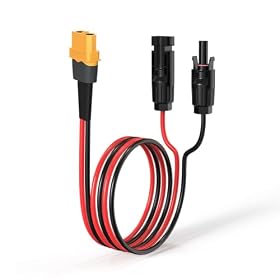
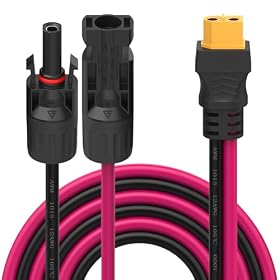
The panel and power station need compatible connectors, correct polarity, and a cable rated for the electrical load. A physical fit does not guarantee correct wiring.
Before buying, verify:
The connector on the power station’s solar input.
The connector supplied with the panel.
Whether a conversion cable is required.
The cable’s voltage and current rating.
The correct positive and negative polarity.
Do not cut and rewire a solar cable unless you understand the polarity and the manufacturer permits it. A purpose-made adapter is usually the safer choice. Keep connector joints dry and protected from rain unless they are specifically rated for outdoor exposure.
Be careful when connecting multiple foldable panels
Connecting panels in series increases voltage. Connecting them in parallel increases available current. Either arrangement can exceed the power station’s input limits.
Use multiple panels only when the power station manufacturer documents the supported wiring method. Check the combined voltage, current, and wattage before connecting anything. Do not connect panels in series if the combined voltage could exceed the station’s maximum solar-input voltage.
Choose the panel type that suits your setup
Direct-connect foldable solar panel
This is the simplest option when the panel’s output and connector are designed to work with the power station. It is convenient for camping and emergency charging, but you still need to verify the input specifications.
Panel with an adapter cable
An adapter can solve a connector mismatch, but it does not solve an electrical mismatch. A cable that physically connects two devices cannot make an excessive voltage safe. Confirm the panel’s specifications before purchasing the adapter.
Portable panel with a built-in regulator
Some portable solar products are designed to provide a regulated output for particular devices. Others expose the panel’s raw solar output. Check whether the power station expects a solar-panel input or a regulated DC supply, and follow both manufacturers’ instructions. Do not add a separate charge controller unless the system is designed for one; the power station may already include its own solar charge controller.
A practical compatibility checklist
Before ordering, confirm all of the following:
The panel’s maximum voltage is within the station’s solar-input voltage range.
The panel’s operating voltage is suitable for that range.
The panel’s maximum current does not exceed the station’s input limit.
The panel’s rated wattage is at or below the station’s accepted solar wattage, unless the manufacturer explicitly permits otherwise.
The connector, polarity, and cable are compatible.
Any series or parallel connection stays within every input limit.
The panel is intended for the charging method described in the power station manual.
Save the product specification page or manual before buying. Marketplace listings sometimes emphasize wattage while omitting important voltage or connector details.
What to expect while charging
A correctly matched panel may still produce substantially less than its advertised rating. Place it in unobstructed sunlight, unfold it fully, aim it toward the sun, and avoid placing it behind ordinary glass. Keep the panel surface clean and prevent folds or shadows from covering cells.
If the station shows no solar input, check the connector first, then confirm that the panel is in direct sunlight and that its voltage falls within the station’s accepted range. Some stations will not begin charging until the panel produces enough voltage. If charging starts and stops, look for intermittent cable connections, moving shadows, excessive heat, or a voltage that is too close to the station’s minimum.
Disconnect the panel before changing wiring or adapters. Stop using the setup if a connector becomes hot, smells unusual, is discolored, or shows damage. For uncertain wiring, polarity, or series connections, contact the power-station manufacturer or a qualified technician rather than guessing.
When a different panel is the better choice
Replace or return the panel when its voltage exceeds the station’s input limit, its specifications are missing, the connector cannot be safely adapted, or the manufacturer does not confirm compatibility. If the panel is compatible but charges slowly, a higher-wattage panel may help only if the station can accept the additional wattage and the voltage and current remain within limits.
The safest purchase is not necessarily the panel with the highest wattage. It is the foldable panel whose complete electrical specifications fit comfortably within the power station’s documented solar-input range.
FAQ
Can I use any foldable solar panel with a portable power station?
No. The panel must match the power station’s solar-input voltage range, current limit, wattage limit, connector, and polarity. A matching connector alone does not confirm compatibility.
Should the solar panel wattage equal the power station’s maximum solar input?
It can be equal to or below the documented maximum if voltage and current also match. A panel rated higher than the station’s maximum may not charge faster and can be unsuitable if it exceeds the station’s voltage or current limits.
Can I connect two foldable solar panels to one power station?
Only if the power station supports multiple panels or the intended series or parallel configuration. Combining panels changes voltage or current, so calculate the combined values and keep them within every input limit.
Why does my solar panel produce less power than advertised?
The advertised rating is a peak value. Cloud cover, shade, panel angle, heat, dirt, cable losses, and the power station’s input limit can all reduce charging power.
What should I do if the panel connects but the power station does not charge?
Check the connector and polarity, place the panel in direct unobstructed sunlight, confirm the panel voltage is within the station’s input range, and inspect the cable for damage or loose connections. Stop if any connector becomes hot or damaged, and consult the manufacturer for uncertain wiring.