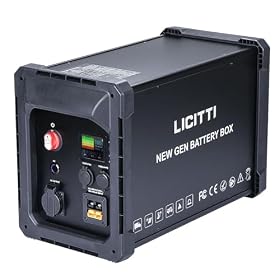
If gasoline generators are prohibited at your site, choose a battery power station based on the loads you need to run, startup surge, runtime, recharge options, and indoor-use restrictions.
If you cannot have gasoline on site, the best alternative is a portable power station with a pure sine wave inverter, enough watt-hours for your loads, and a recharge plan that does not depend on fuel. For a refrigerator or other motor-driven appliance, pay particular attention to inverter surge capacity and the station’s ability to start the load—not just its advertised battery capacity.
A battery power station produces no exhaust while operating, making it more suitable than a fuel generator for many indoor-adjacent, apartment, event, worksite, and campground situations. It still has electrical and battery-safety limits, so follow the manufacturer’s instructions and local rules.
What to look for first
1. Enough capacity for the required runtime
Capacity is usually listed in watt-hours (Wh). A rough runtime estimate is:
For a quick planning estimate, using about 80% of the listed capacity accounts for inverter losses and the manufacturer’s reserve. Actual runtime varies with temperature, battery age, appliance cycling, and the station’s low-battery shutdown settings.
A refrigerator does not normally draw its maximum running power continuously, but it can run longer during hot weather or frequent door openings. If you also need lights, networking equipment, medical devices, or phone charging, add those loads to the plan instead of sizing for the refrigerator alone.
2. A pure sine wave inverter
Choose a station with a pure sine wave AC inverter for refrigerators, pumps, fans, chargers, and other sensitive or motor-driven equipment. It provides AC power that more closely matches utility power and is the safer default when the appliance manufacturer does not explicitly approve another waveform.
3. Adequate continuous and surge output
The inverter has two important output ratings:
Continuous output: the power it can supply during normal operation.
Surge or peak output: the short burst available when a motor starts.
A refrigerator can draw more power briefly when its compressor starts. The station must support both the appliance’s running demand and its startup surge. If the station repeatedly shuts down when the refrigerator starts, its inverter may be undersized, the battery may be low, or another load may be using the available output.
Do not assume that a larger battery automatically has a stronger inverter. Check both ratings in the manufacturer’s specifications.
Battery chemistry and service life
Many current power stations use lithium iron phosphate, commonly called LiFePO4, while others use different lithium chemistries. LiFePO4 is often selected for its cycle-life and thermal characteristics, but chemistry alone does not determine whether a station fits your needs.
Also check:
The manufacturer’s stated cycle-life conditions
The permitted operating and charging temperature range
Whether the battery management system provides over-temperature, over-current, and low-voltage protection
Whether the battery is user-replaceable or serviceable
The warranty terms and support availability
Do not charge or operate the unit outside the temperature limits in its manual. Avoid storing it fully depleted, and inspect the enclosure, cables, and charging ports before use.
Product prices and availability are accurate as of the date/time indicated and are subject to change. Any price and availability information displayed on Amazon.com at the time of purchase will apply to the purchase of this product.
Charging options when gasoline is not allowed
A station is more useful when it has multiple ways to recharge:
AC wall charging: Usually the fastest and most predictable option before an outage or job.
Solar charging: Useful for extended outages, remote work, and camping, but output depends on sunlight, panel orientation, temperature, and the station’s solar-input limits.
Vehicle charging: Helpful while traveling, although it is generally slower and may require the vehicle to be running.
Extra battery expansion: Worth considering if you need longer runtime and the station supports a compatible expansion battery.
Match the solar panel’s voltage, current, connector, and total input power to the station. Do not connect panels in a configuration that exceeds any listed input limit. Use only compatible cables and adapters.
Product prices and availability are accurate as of the date/time indicated and are subject to change. Any price and availability information displayed on Amazon.com at the time of purchase will apply to the purchase of this product.
Features that matter at a no-gas site
Low noise
Battery stations are much quieter than fuel generators because they do not use an engine. Fans may still run during high output or charging. If the station will be used in a bedroom, office, booth, or quiet campsite, check the manufacturer’s noise information and whether the fan runs continuously under load.
UPS or backup switching
A station with an uninterruptible power supply function may keep selected electronics powered when utility power fails. However, transfer time and compatibility matter. Some refrigerators, computers, medical devices, and other equipment may not tolerate every backup mode.
Test the specific appliance combination before relying on it for critical operation. For medical equipment or life-safety systems, use a backup solution approved by the equipment manufacturer or a qualified professional.
Ports and output layout
Count the connections you actually need: AC outlets, USB-C, USB-A, 12-volt ports, and any specialty outputs. Confirm the USB-C port’s power delivery rating if you need to charge a laptop or other higher-power device.
A station with more ports is not necessarily able to deliver full rated power through all of them simultaneously. Check the combined-output limits.
Display and controls
A readable display should show battery percentage, input power, output power, estimated runtime, and warnings. App controls can be convenient, but the station should still provide basic local controls if connectivity is unavailable.
Sizing examples
Use the appliance labels or a plug-in power meter to estimate demand where possible. For a refrigerator, measure or observe its energy use over time rather than sizing from the compressor’s label alone.
As a planning method:
List each appliance and its expected watts.
Estimate how many hours each will operate.
Add the watt-hours together.
Add a margin for startup surges, inverter losses, cold weather, and unexpected use.
Confirm that the station’s continuous and surge ratings support the largest starting load.
For example, a refrigerator that cycles on and off may need far less stored energy over several hours than its maximum running wattage multiplied by every hour. But that does not eliminate the need for sufficient startup surge capacity.
Safe use where gasoline is prohibited
A battery power station has no fuel exhaust during operation, but it is not risk-free. Keep it dry unless the manufacturer specifically rates it for the conditions, provide ventilation around cooling openings, and keep it away from heat sources and flammable materials.
Do not connect a power station to a building’s wiring or electrical panel with an improvised cord. Backfeeding can injure utility workers and damage equipment. Use only a properly installed transfer solution approved for the station and building, and have a qualified electrician handle permanent connections.
Never modify battery packs, bypass protective circuits, or use damaged charging cables. Stop using the unit if it is swollen, unusually hot, leaking, emitting an odor, or showing physical damage.
When a portable power station is not the right choice
A battery station may be a poor fit if you need to run high-wattage heating appliances, large air conditioners, welders, compressors, or multiple motor loads for long periods. Those uses can require substantial battery capacity, a high-output inverter, and frequent recharging.
It may also be unsuitable if the site prohibits lithium batteries, has severe temperature exposure, or requires certified equipment for a specific industry or event. Confirm the site’s rules before purchasing.
Bottom line
The best station for a no-gasoline site is not automatically the largest model. Choose a pure sine wave unit with enough usable watt-hours, adequate motor-starting surge, safe temperature limits, and a practical AC, solar, or vehicle charging plan. For a refrigerator, verify both the compressor startup requirement and the expected runtime. If the load is critical, test the complete setup before an outage or event and keep a backup charging plan available.
FAQ
Can a portable power station be used where gasoline generators are prohibited?
Often, yes. A battery power station has no engine exhaust while operating, but the site may have separate rules for lithium batteries, charging, indoor use, or electrical equipment. Confirm the property, event, campground, workplace, or local requirements first.
What size portable power station will run a refrigerator?
It depends on the refrigerator’s startup surge, average energy use, and the desired runtime. Choose a pure sine wave inverter with sufficient continuous and surge output, then estimate watt-hours from measured or manufacturer-provided energy use. Add capacity for other devices and unexpected cycling.
Can a portable power station run indoors?
Many are designed for indoor-adjacent use because they produce no carbon monoxide during operation, but they still need ventilation around cooling openings and must be kept dry and away from heat. Follow the specific manual and site rules.
Is a solar panel necessary if gasoline is not allowed?
No, but solar charging can extend runtime during a long outage or remote stay. AC charging is usually the simplest way to prepare, while vehicle charging can provide another backup option.