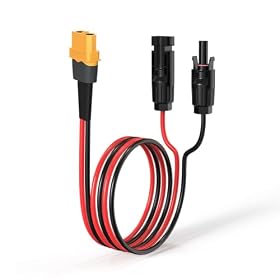
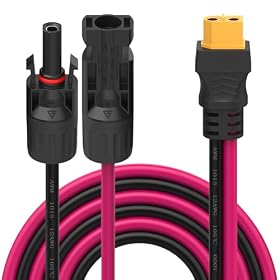
The right solar panel must fit your power station’s voltage, current, wattage, connector, and charging requirements—not just its advertised panel wattage.
What do you need help with?
Open an answer, or tell us what we should cover next.
Answered in this guide
Choose a solar panel that matches your power station
Start with the power station’s solar-input limits, then match the panel’s voltage, current, wattage, connector, and polarity. The panel must stay within the station’s electrical limits and provide a compatible connection.
Compare a panel’s voltage, current, and wattage ratings
Compare Voc, Vmp, Imp, and rated wattage with the power station’s input limits. Voc must not exceed the station’s maximum voltage, while the panel’s operating voltage, current, and wattage should fit its charging range.
Confirm that the panel plug matches the power station’s input and that the positive and negative connections use the correct polarity. A panel can have suitable electrical ratings but still fail to connect safely.
Diagnose why a connected solar panel is not charging
Check sunlight and panel orientation first, then verify the connector, polarity, voltage, current, and power-station input settings. These checks help identify why charging has not started even when the panel is connected.
Requests help us prioritize the next guide. No email required.
One anonymous request per topic.
A solar panel matches a portable power station when its output stays within the power station’s solar-input limits and its connector and polarity are compatible. Before buying, compare the panel’s open-circuit voltage (Voc), operating voltage (Vmp), operating current (Imp), and rated wattage with the input specifications printed on the power station or listed in its manual.
Start with the power station’s solar-input specifications
Find the line labeled solar input, PV input, or DC input. You need to identify:
Maximum input voltage: The highest voltage the station can safely accept.
Operating voltage range: The voltage range required for solar charging to begin and continue.
Maximum input current: The highest current the solar input can use.
Maximum solar-input wattage: The most power the station can accept from panels.
Connector type and polarity: The plug size, connector style, and positive/negative arrangement.
These limits are specific to the power station. Do not assume that two stations with similar battery capacities use the same solar input.
If the manual lists only a maximum voltage and wattage, check with the manufacturer before connecting an unfamiliar panel. A panel that exceeds the voltage limit can damage the charging system, while a panel with too little voltage may not charge the station reliably.
Compare the panel’s key ratings
Solar panels commonly list four ratings that matter for compatibility:
Open-circuit voltage: Voc
Voc is the panel’s voltage when it is not supplying a load. This is the critical safety number when checking the station’s maximum input voltage.
The panel’s Voc should remain below the power station’s maximum solar-input voltage. Cold temperatures can increase a panel’s voltage, so avoid choosing a panel whose listed Voc is very close to the station’s limit. For series-connected panels, add the Voc values together before comparing them with the station’s maximum.
Maximum-power voltage: Vmp
Vmp is the panel’s approximate voltage while producing its rated power. It should fall within the power station’s stated solar-input operating range.
A panel may have a safe Voc but still perform poorly if its normal operating voltage is below the station’s minimum charging voltage.
Maximum-power current: Imp
Imp is the panel’s approximate operating current at its rated output. Compare it with the power station’s maximum solar-input current.
If a panel can produce more current than the station accepts, the station may limit the current, so the full panel rating may not be used. The exact behavior depends on the station’s charge controller. Never exceed the manufacturer’s current limit unless the manufacturer explicitly says the input can handle it.
Rated wattage
Panel wattage is broadly calculated from voltage multiplied by current. A panel rated above the station’s maximum solar-input wattage may still be usable if the station limits incoming power, but the excess rating will not necessarily produce faster charging.
The panel’s rated output is also measured under laboratory conditions. Shade, angle, temperature, dust, clouds, and cable losses can reduce actual charging power. Treat the wattage rating as a ceiling or comparison point, not a guaranteed charging rate.
Product prices and availability are accurate as of the date/time indicated and are subject to change. Any price and availability information displayed on Amazon.com at the time of purchase will apply to the purchase of this product.
Check the connector and polarity
Electrical compatibility is not enough. The plug must also fit correctly.
Check:
Plug or socket type
Plug dimensions, including barrel diameter if applicable
Positive and negative polarity
Whether the panel includes the required adapter
Whether the cable is rated for the expected current and outdoor use
Do not force a connector that almost fits. Do not rely only on a product listing that says “compatible.” Confirm the adapter and polarity against the power station’s manual or the panel manufacturer’s documentation.
Many folding or portable panels use a proprietary output connector, while power stations may use a separate solar adapter cable. If an adapter is required, it should be designed for that connection rather than improvised from unrelated cables.
Product prices and availability are accurate as of the date/time indicated and are subject to change. Any price and availability information displayed on Amazon.com at the time of purchase will apply to the purchase of this product.
Decide whether one panel or multiple panels makes sense
One panel is usually the simplest option. Multiple panels can increase charging power, but the wiring method changes the electrical result.
Panels in series
Connecting panels in series adds their voltages while the current remains approximately that of one panel. This can exceed the power station’s maximum input voltage, especially when the panels’ Voc values are added together.
Use series wiring only when the combined voltage stays within the power station’s permitted range under the manufacturer’s guidance.
Panels in parallel
Connecting panels in parallel adds their currents while voltage remains approximately the same. This can exceed the station’s maximum input current.
Parallel connections may also require appropriate branch connectors, fuses, or other equipment depending on the system. Follow the power station and panel manufacturer’s wiring instructions.
Built-in solar charging controllers
Some portable power stations accept panels directly through a built-in charge controller. Others may require a specific input range or adapter. Do not add a separate charge controller unless the manufacturer specifically permits it; an incompatible controller can interfere with charging or create an unsafe connection.
Product prices and availability are accurate as of the date/time indicated and are subject to change. Any price and availability information displayed on Amazon.com at the time of purchase will apply to the purchase of this product.
Choose the panel type
Portable folding panels
Folding panels are convenient for camping and emergency use because they are easier to carry and set up. Check whether the advertised wattage applies to the entire folded panel assembly and whether its output connector matches your station or requires an adapter.
Rigid framed panels
Rigid panels can make sense for a semi-permanent setup, such as a cabin, shed, or emergency charging station. They generally need a suitable mounting location, weather-resistant wiring, and a properly planned cable run.
Manufacturer-branded panels
A panel sold by the power-station manufacturer may simplify connector and compatibility questions, but it is still important to compare the electrical specifications. “Designed for” does not by itself confirm compatibility with every model in a product family.
Account for real-world charging conditions
A panel reaches its rated output only under specified test conditions. Charging may be slower when:
The panel is partly shaded
The panel is pointed away from the sun
The panel is lying flat when the sun angle is low
Clouds or smoke reduce sunlight
The panel is dirty
The panel is hot
The cable is unusually long or undersized
The power station is near its charge limit or has a temperature-related charging restriction
For emergency planning, compare the power station’s battery capacity with a realistic, lower-than-rated solar input. A larger panel can help recover energy sooner, but only up to the power station’s input limit.
A quick compatibility checklist
Before ordering, verify all of these items:
The panel’s Voc is below the power station’s maximum input voltage, with suitable margin for cold conditions.
The panel’s Vmp is within the station’s charging voltage range.
The panel’s operating current does not exceed the station’s maximum input current.
The panel’s wattage is appropriate for the station’s maximum solar-input wattage.
The connector fits, or a manufacturer-approved adapter is available.
Polarity is correct.
Any series or parallel combination remains within voltage and current limits.
The cables are suitable for the panel’s output and outdoor conditions.
The panel can be positioned where it will receive adequate sunlight.
What to do if the power station will not charge
If the panel is connected but charging does not start, use this order of checks:
Confirm sunlight and orientation. Move the panel into direct sunlight and remove shade from any section of the panel.
Check every connection. Reseat the panel cable and adapter at both ends. Inspect for bent contacts, damage, moisture, or a loose fit.
Verify polarity and connector compatibility. A physically similar plug may still be wired differently.
Compare voltage ratings again. Make sure the panel’s Vmp reaches the station’s minimum charging voltage and its Voc stays below the maximum.
Remove extra panels or adapters. Test with one known-compatible panel before troubleshooting a series or parallel arrangement.
Check the power station’s operating temperature and charge settings. Some stations pause charging when too hot, too cold, full, or configured for a different input mode.
Inspect the cable. A damaged, excessively long, or unsuitable cable can cause voltage drop.
If the input shows an over-voltage, over-current, or connection fault, disconnect the panel and consult the power station’s manual. Do not repeatedly reconnect a setup that exceeds the stated limits.
When to choose a different panel
Choose a different panel when its Voc is too close to or above the station’s maximum, its Vmp is below the required charging range, its connector or polarity cannot be safely matched, or its electrical ratings are unclear.
If a correctly matched panel still produces no input in suitable sunlight, the problem may be the cable, adapter, panel, or power station’s solar-input circuit. Replace a visibly damaged cable or adapter with a correctly rated part. If the panel and connections are confirmed compatible but the station still reports a fault, contact the manufacturer or have the equipment evaluated by a qualified professional rather than opening the power station.
FAQ
Can I use any solar panel with a portable power station?
No. The panel must fit the station’s voltage range, maximum voltage, current limit, wattage limit, connector, and polarity requirements. Check the power station manual and the panel’s electrical label before connecting it.
Is a higher-wattage solar panel always better?
No. A higher-rated panel may charge faster only up to the power station’s solar-input limit. If its voltage or current exceeds the station’s limits, it may be unsafe or incompatible.
What is the most important solar-panel number to check?
Check Voc first against the power station’s maximum input voltage, then compare Vmp with the station’s operating range and Imp with its maximum input current. Wattage and connector compatibility also matter.
Can I connect two solar panels to one power station?
Possibly, but the wiring method matters. Series connections add voltage, while parallel connections add current. Calculate the combined values and keep them within the power station’s stated limits.
Why does my panel produce less power than its advertised wattage?
Rated wattage is measured under defined conditions. Shade, clouds, panel angle, heat, dust, cable losses, and the power station’s own input limit can all reduce the power shown during charging.