A solar panel usually costs extra on top of a portable power station unless you buy a bundle that specifically includes one. For budgeting, separate the station price from the panel, then account for connector cables, a longer extension cable, and possibly an extra battery. The right panel depends on the station’s solar-input limits—not simply on the largest wattage you can find.
Solar · Mon Sep 07
Solar panel cost on top of the station
A solar panel is an additional purchase unless it is included in a portable power station bundle. The final cost depends mainly on panel wattage, portability, connector compatibility, and whether you need extra cables or mounting equipment.
What adds to the cost?
The solar panel itself
Panel wattage is the biggest pricing factor. Smaller portable panels are easier to carry and may be adequate for compact power stations. Higher-wattage folding panels can recharge larger stations faster, but they generally cost more and take up more space when stored.
A panel’s advertised wattage is its maximum rating under favorable conditions. Actual output varies with sunlight angle, cloud cover, temperature, shading, and the panel’s orientation. A panel rated at a station’s maximum supported input will not necessarily deliver that input throughout the day.
Cables and adapters
Check whether the panel includes the cable needed to connect to your power station. Many portable power stations use an input cable with a common solar connector, but connector style, polarity, voltage range, and current limits still need to match.
You may also need:
- A longer solar extension cable if the panel must sit away from the station
- A connector adapter for an incompatible plug type
- Cable organizers or weather-resistant storage
- A protective case if the panel does not include one
Do not assume that a connector physically fitting means the electrical specifications are safe. Follow the power station and panel manufacturers’ voltage, current, and connection instructions.
A bundle premium
Some manufacturers sell a station and panel together. A bundle can be convenient and may include the correct cable, but it is not automatically the lowest-cost option. Compare what is included: panel wattage, cable length, carrying case, warranty coverage, and whether the panel is a rigid, folding, or flexible design.
Compatible portable solar panel
 Renogy 100W Portable Solar Panel, 25% High Efficiency Solar Panel Kit with 20A Charger Controller…Renogy
$229.30 as of
View on Amazon SOLPERK Solar Panel Kit 20W 12V Solar Battery Charger Maintainer+ControllerSOLPERK
$34.99 as of
View on Amazon Jackery DC Extension Cable Plus for Solar Panel 32.8 feet / 10 MeterJackery
$59.00 as of
View on Amazon
Product prices and availability are accurate as of the date/time indicated and are subject to change. Any price and availability information displayed on Amazon.com at the time of purchase will apply to the purchase of this product.
How to choose the right panel for your station
Look at the station’s solar-input specifications before shopping. The important figures are:
- Maximum solar input wattage: The most power the station can accept
- Operating voltage range: The panel’s voltage must fall within the station’s supported range
- Maximum input current: A panel or panel combination should not exceed the station’s limit
- Connector and polarity: The plug must be compatible or connected with an approved adapter
- Input behavior: Some stations limit or stop solar charging when the battery is full or when temperatures are outside the operating range
A panel rated below the station’s maximum input may charge it safely but more slowly. A panel rated above the input limit may not make the station charge faster, because the station can restrict the incoming power. Exceeding voltage or current limits can damage equipment and may create a safety hazard.
For a small station used to recharge phones, lights, or a laptop, portability may matter more than maximum charging speed. For outage preparation or a larger station intended to support a refrigerator, a higher-output solar setup may be more useful, provided it remains within the station’s input limits.
Solar extension cable
 Jackery DC Extension Flat Cable Plus for Solar Panel 32.8 feet / 10 MeterJackery
$59.00 as of
View on Amazon- Jackery DC Extension Cable Plus for Solar Panel 32.8 feet / 10 MeterJackery
$59.00 as of
View on Amazon  UCANUUP 30FT Solar Extension Cable for Jackery SolarSaga & ExplorerUCANUUP
$26.99 as of
View on Amazon
Product prices and availability are accurate as of the date/time indicated and are subject to change. Any price and availability information displayed on Amazon.com at the time of purchase will apply to the purchase of this product.
Rigid, folding, or flexible panels?
Folding portable panels
Folding panels are designed for camping and temporary setups. They are easier to transport and position, but the hinges, fabric, and stands can add wear points. They also need a stable area where all sections receive similar sunlight.
Rigid panels
Rigid panels are often better suited to a semi-permanent installation, such as a cabin, van, or dedicated emergency-power setup. They can require mounting hardware and more planning, so the panel price is only part of the installation cost.
Flexible panels
Flexible panels can fit curved surfaces and may be lighter than rigid models. However, mounting method, ventilation, bend limits, and long-term exposure matter. Use them only in ways approved by the panel manufacturer.
Solar connector adapter
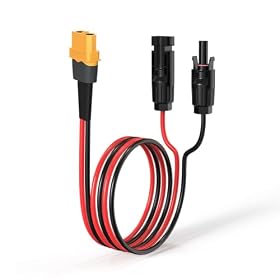 ELFCULB 10AWG 6FT XT60 Solar Cable 2 6 10 25 35 50 75 100FT XT60…ELFCULB
$18.88 as of
View on Amazon ELFCULB 12AWG 25FT Solar to XT60i Cable 2 10 25 35 50 75 100FT Solar…ELFCULB
$34.88 as of
View on Amazon BougeRV Solar Connectors Y Branch Parallel Adapter Cable Wire Plug Tool Kit for Solar PanelBougeRV
$8.99 as of
View on Amazon
Product prices and availability are accurate as of the date/time indicated and are subject to change. Any price and availability information displayed on Amazon.com at the time of purchase will apply to the purchase of this product.
Estimating the complete solar budget
Use this checklist rather than comparing panel prices alone:
- Confirm the station’s maximum solar wattage, voltage range, current limit, and connector.
- Choose a panel or panel combination that stays within those limits.
- Add the cost of a compatible cable or adapter if one is not included.
- Add an extension cable if the panel will be positioned away from the station.
- Include a case, mounting equipment, or protective storage if needed.
- Decide whether an extra battery is more useful than a larger panel for your intended runtime.
A larger panel can improve daytime recharge speed, but it does not increase the station’s stored capacity. An extra battery increases available storage on compatible systems, while a solar panel replenishes that storage. For overnight outages, a combination of adequate battery capacity and daytime solar input may be more practical than spending the entire additional budget on a panel.
Is a solar panel worth adding?
A panel is more valuable when you expect extended outages, spend multiple days off-grid, or need to preserve fuel and vehicle charging capacity. It may be less useful if you only need emergency power for a few hours and can recharge the station from a wall outlet afterward.
Before buying, estimate the loads you actually need to run. A refrigerator, medical device, heater, or high-wattage appliance can consume far more energy than phones and lights. Solar charging also depends on having usable sunlight during the day, so it should not be treated as a guaranteed replacement for grid or generator power.
For refrigerator backup, check both the station’s continuous output rating and its surge capability. The solar panel affects recharge time; it does not determine whether the station can start or continuously operate the refrigerator.
Common buying mistakes
- Buying a panel whose voltage is outside the station’s accepted range
- Assuming the panel’s maximum wattage is its normal continuous output
- Forgetting that an adapter may change connector compatibility but not electrical limits
- Using a solar extension cable that is too long or unsuitable for the system
- Expecting a panel to charge normally through heavy shade or cloudy weather
- Choosing a rigid panel without budgeting for mounting and transport
- Buying several panels without checking the station’s combined voltage and current limits
Never connect panels in series or parallel unless the station and panel instructions support that configuration. If the wiring arrangement is unclear, contact the manufacturer or have a qualified professional verify it.
When a different upgrade makes more sense
A solar panel is not always the best next purchase. Consider an extra battery if your station supports one and your main problem is insufficient overnight capacity. Consider a car-charging cable if you frequently travel and need a dependable charging option while driving. If your station has a low solar-input limit, replacing the station with a model designed for more solar input may be more practical than buying an oversized panel it cannot use.
FAQ
Does a portable power station usually include a solar panel?
Not always. Many stations are sold by themselves, while some bundles include a panel and connection cable. Check the package contents carefully before comparing the total cost.
Can I use any solar panel with a portable power station?
No. The panel’s voltage, current, wattage, connector, and polarity must be compatible with the station’s solar input. Follow both manufacturers’ specifications.
Will a higher-wattage solar panel charge my station faster?
Only up to the station’s maximum solar-input limit and only when sunlight allows it. A panel rated above that limit may not provide faster charging and can be unsafe if its voltage or current exceeds the station’s specifications.
Do I need an extra solar charge controller?
Portable power stations generally have solar-charging circuitry built into their solar input, but do not assume every setup is interchangeable. Use the connection method specified by the station manufacturer and do not add a separate controller unless the instructions call for one.
Is an extra battery or solar panel the better upgrade?
Choose an extra battery when you need more stored energy, especially overnight. Choose a solar panel when you need to replenish the station during daylight. For longer outages, both may be useful if the station supports the combination.