Foldable panels are easier to carry and set up, while rigid panels are usually better for permanent or semi-permanent installations. The right choice depends on how often you move your solar setup, where you use it, and whether the panel and power station are electrically compatible.
Foldable solar panels are usually the better choice for camping, travel, and temporary outage use because they pack away easily and need little installation. Rigid panels make more sense when you want a durable, semi-permanent setup with predictable positioning. Before buying either type, check the panel’s voltage, current, connector, and maximum input limits against your portable power station.
Foldable solar panels: strengths and limitations
A foldable panel typically uses several panel sections joined by hinges or flexible connections. It may include a carrying handle, storage case, kickstand, or built-in cable.
Advantages
Easy to transport: It folds into a smaller package for a vehicle, campsite, or emergency kit.
Fast setup: You can unfold it, angle it toward the sun, and connect it to the power station.
Good for temporary use: It does not normally require roof mounting, a rack, or permanent wiring.
Simple to store: It can be kept indoors when not in use, reducing exposure to weather and theft.
Limitations
Hinges and cables need care: Repeated folding, sharp bends, dirt, or water intrusion can damage connection points.
The built-in stand may be limited: A lightweight stand can be less stable in wind or on uneven ground.
Panel sections may not all face the sun equally: Uneven ground or partial shade can reduce output.
The package can still be bulky: A higher-output foldable panel may be wide, heavy, or awkward to carry even when folded.
A foldable panel is generally the practical choice if your solar panel will travel with your portable power station or be put away after each use.
Rigid solar panels: strengths and limitations
Rigid panels usually have a solid frame and a glass or similarly protected panel surface. They are commonly used on a vehicle, shed, rack, balcony, or ground-mounted support, although mounting requirements vary.
Advantages
Better suited to long-term placement: A frame can make it easier to secure the panel and maintain a consistent angle.
More resistant to routine handling: Rigid construction avoids the repeated folding and unfolding required by a portable panel.
Easier to expand in a fixed setup: Multiple panels can be arranged with suitable wiring and charge-control equipment.
Often easier to position precisely: A fixed bracket or ground support can keep the panel pointed consistently.
Limitations
Less portable: A rigid panel can be difficult to fit in a car and may require a roof rack or other support.
Installation takes more planning: You may need brackets, fasteners, wiring, weather protection, and a safe way to route cables.
More exposed when left outside: Wind, hail, falling branches, theft, and weather can affect the installation.
Storage is inconvenient: A full-size framed panel takes up more indoor space.
Choose a rigid panel when the panel will stay in one place for much of the season or when portability is less important than a stable installation.
Product prices and availability are accurate as of the date/time indicated and are subject to change. Any price and availability information displayed on Amazon.com at the time of purchase will apply to the purchase of this product.
Key differences that affect your decision
Portability and setup
For camping and short outages, setup time and storage usually matter more than having a permanent mounting system. A foldable panel can be carried with the power station and moved as the sun changes position.
A rigid panel is a better fit when you already have a safe location for it. It can be worth the extra installation work if you want to recharge a power station from the same location repeatedly.
Durability
Neither design should be treated as indestructible. A foldable panel needs protection from crushed hinges, dangling cables, and rough handling. A rigid panel needs protection from impact, insecure mounting, and excessive wind loading.
Follow the panel manufacturer’s instructions for rain and storage. Water resistance can apply differently to the panel, junction box, connectors, and attached cable. Do not assume that a water-resistant panel makes the connected power station safe to leave outdoors.
Sun positioning and shade
Both panel types need direct sunlight for useful charging. Output changes throughout the day and can fall sharply from shade, clouds, dirt, incorrect angle, or nearby obstructions.
A foldable panel is easier to reposition, which can be valuable at a campsite. A rigid panel may produce more consistent results if it is securely mounted in an unobstructed location, but only if the installation is positioned well.
Weight and carrying comfort
Compare the complete system weight, not just the panel rating. Include the case, stand, cable, and any adapter. A panel that is technically portable may still be inconvenient if it is too heavy for the person who must carry it.
For vehicle camping, weight may be less important than packed dimensions. For hiking or emergency evacuation, folded size and carrying comfort become much more important.
Rigid panel for a fixed portable power station setup
Product prices and availability are accurate as of the date/time indicated and are subject to change. Any price and availability information displayed on Amazon.com at the time of purchase will apply to the purchase of this product.
Check compatibility with your portable power station
A panel is not automatically compatible just because it uses a common-looking connector. Check these specifications before buying:
Solar input voltage range: The panel’s operating voltage must fall within the power station’s accepted solar charging range.
Maximum solar input current: A panel or panel combination should not exceed the station’s allowed current.
Maximum solar input wattage: The power station may limit how much charging power it can accept, even if the panel is rated higher.
Open-circuit voltage: This can rise in bright, cold conditions and must remain below the power station’s maximum input voltage.
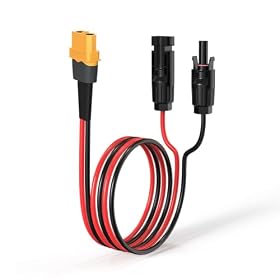
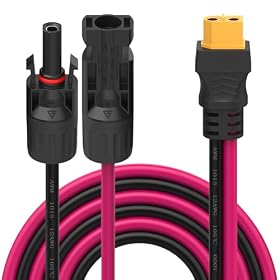
Connector type and polarity: The plug must fit correctly and be wired as required by the manufacturer.
Series or parallel rules: Do not combine panels until you understand how the wiring changes voltage and current.
The panel’s advertised wattage is a laboratory or peak rating, not a guaranteed charging rate. Real charging power varies with sunlight, temperature, panel angle, shade, cable losses, and the power station’s own charging limits.
If the specifications are unclear, use the portable power station manufacturer’s approved panel or adapter guidance. Do not force a connector or use an improvised cable for a high-power connection.
Product prices and availability are accurate as of the date/time indicated and are subject to change. Any price and availability information displayed on Amazon.com at the time of purchase will apply to the purchase of this product.
Which type is better for common uses?
Camping and road trips
A foldable panel is usually the better match. It packs with your gear, can be moved around a campsite, and does not require a permanent mount. Prioritize a manageable folded size, a stable stand, a sufficiently long cable, and weather guidance that fits your use.
Home emergency backup
Either type can work. A foldable panel is easier to store and deploy during an outage. A rigid panel may be preferable if you have a secure ground location or an existing mounting system, but do not create an unsafe temporary roof or balcony installation.
Recharging a power station at a fixed location
A rigid panel is often more convenient if the setup will remain in place. Plan for secure mounting, cable protection, weather exposure, and a safe way to disconnect the panel when necessary.
Occasional recreational use
Choose the foldable design if the panel will spend most of its time in storage. A rigid panel is harder to justify if you must transport and set it up every time.
How much solar panel should you buy?
Start with the portable power station’s solar input limit rather than choosing the highest-wattage panel available. A panel rated above that limit may not charge faster, and an electrically incompatible panel can damage equipment or create a safety hazard.
Then consider your actual charging conditions:
Identify the power station’s solar input voltage, current, and wattage limits.
Estimate where the panel will be used and how often it will be shaded.
Decide whether the panel must be carried by hand or mounted in one place.
Compare the panel’s packed dimensions and total weight.
Confirm the connector and any required adapter.
Check whether the manufacturer permits panels to be combined.
If you need faster charging, a larger compatible panel or multiple compatible panels may help, but only within the power station’s input limits and the manufacturer’s wiring instructions.
Troubleshooting slow solar charging
If a compatible panel is charging slowly, check the simple causes first:
Remove shade and reposition the panel. Even partial shade can reduce output.
Aim the panel more directly at the sun. Recheck its position as the sun moves.
Clean the panel surface. Dust, pollen, and bird droppings can reduce available sunlight.
Inspect the cable and connectors. Look for loose plugs, bent contacts, cuts, heat damage, or moisture.
Confirm the power station is accepting solar input. Its display or app may show input watts or a charging status.
Check the electrical limits again. An incorrect adapter, excessive voltage, or input-current limit can prevent charging.
Allow for temperature and weather. Cloud cover, heat, and low sun angle can substantially reduce output.
Disconnect the equipment and follow the manufacturer’s instructions if a connector becomes hot, smells unusual, shows arcing, or has visible damage. Do not open or repair a power station unless the manufacturer specifically permits it and you are qualified to do so.
Bottom line
Choose a foldable solar panel for portability, quick setup, camping, vehicle travel, and temporary emergency charging. Choose a rigid panel for a more permanent location where secure mounting, repeatable positioning, and long-term use matter more than compact storage.
In either case, electrical compatibility is the deciding specification. Confirm voltage, current, wattage, connector, polarity, and series/parallel limits before connecting a panel to a portable power station.
FAQ
Are foldable solar panels as effective as rigid panels?
They can provide similar useful charging when their electrical ratings and sunlight conditions are comparable. Real-world output depends more on panel capacity, shade, angle, temperature, wiring, and the power station’s input limit than on the folding design alone.
Can I leave a foldable solar panel outside?
Only if the manufacturer’s instructions allow the expected weather exposure. Protect the power station, connectors, and cable connections separately, and bring the panel indoors when conditions exceed its rated use or when it will be unattended.
Can I connect a rigid solar panel directly to a portable power station?
Sometimes, but only when the panel’s voltage, current, wattage, connector, polarity, and open-circuit voltage are within the power station’s specifications. Use the required manufacturer-approved cable or adapter.
Is a higher-wattage solar panel always better?
No. A portable power station may accept only a limited amount of solar input. A higher-rated panel may not charge faster and could be unsafe if it exceeds the station’s voltage or current limits.
Which solar panel type is better for an outage?
A foldable panel is easier to store and deploy temporarily. A rigid panel can be useful if it is already mounted safely or you have a prepared location for it. Choose based on your storage, setup, and compatibility requirements.