A solar suitcase is usually easier to angle and carry, while a single large foldable panel can offer a simpler, lower-profile setup. The better choice depends on your power station’s solar-input limits, available space, and how often you move the system.
A solar suitcase is usually the better choice when you want an easy-to-carry panel that can stand at an angle, while a single large foldable panel may be simpler when you have a clear, stable area for setup. Before choosing, match the panel’s voltage, current, connector, and total wattage to the solar-input specifications of your portable power station.
What the terms usually mean
A solar suitcase generally consists of two or more rigid or semi-rigid panels joined by hinges, with a folding frame, kickstand, or carrying handle. It is designed to open like a case and sit at a useful angle.
A single large foldable panel is usually one continuous flexible or semi-flexible panel that folds into sections. It may be lighter or thinner than a suitcase-style panel, but it often needs a separate way to hold it at the desired angle.
These names are not standardized. Check the actual panel dimensions, folded size, weight, construction, connectors, and electrical specifications rather than relying on the product label alone.
Solar suitcase versus a single large foldable panel
Factor
Solar suitcase
Single large foldable panel
Setup
Often opens into a self-supporting arrangement
May need a table, ground support, or separate stand
Portability
Convenient to carry, but can be bulky and rigid
Often flatter and easier to store in narrow spaces
Positioning
Hinges or kickstands can make aiming easier
May be harder to angle without extra support
Durability
Rigid panels and protected corners can handle regular setup well
Flexible materials can pack efficiently but need careful handling
Shading
Multiple sections do not automatically eliminate shading losses
A large shaded section can reduce useful output substantially
Storage
Case-like shape may take more closet or vehicle space
Folded shape may fit more easily in a vehicle or storage bin
Product prices and availability are accurate as of the date/time indicated and are subject to change. Any price and availability information displayed on Amazon.com at the time of purchase will apply to the purchase of this product.
Choose a solar suitcase when setup and positioning matter
A solar suitcase is a strong option for camping, emergency charging, or any situation where you will repeatedly move the panel. Hinged sections and built-in legs can make it easier to face the panel toward the sun without carrying a separate stand.
It can also be practical when the ground is uneven. You may be able to adjust the panel’s orientation by changing the angle of the case or repositioning its sections.
The tradeoff is bulk. A suitcase-style panel can be awkward to carry through a narrow doorway, store in a small vehicle, or place on a compact balcony. Its frame and hardware may also add weight compared with a flexible foldable panel of similar rated wattage.
Product prices and availability are accurate as of the date/time indicated and are subject to change. Any price and availability information displayed on Amazon.com at the time of purchase will apply to the purchase of this product.
Choose a single large foldable panel when storage and simplicity come first
A single large foldable panel can make sense when you have a relatively open, shaded-free area and a reliable way to support it. Its flatter folded form may slide behind vehicle seats or into a storage compartment more easily than a rigid suitcase.
This style is useful when you want to lay the panel on a stable surface temporarily. However, avoid placing a flexible panel where it can be stepped on, sharply creased, dragged, or exposed to standing water unless the manufacturer specifically allows it.
A single large panel may be less convenient if you need to change its angle throughout the day. Without a built-in stand, you may have to use a safe support arrangement that will not damage the panel or allow wind to move it.
Product prices and availability are accurate as of the date/time indicated and are subject to change. Any price and availability information displayed on Amazon.com at the time of purchase will apply to the purchase of this product.
Check compatibility with your portable power station
Rated wattage is only one part of compatibility. Before buying either panel type, compare its specifications with the power station’s solar-input limits.
Confirm the solar-input voltage range
The panel’s operating voltage and open-circuit voltage must be suitable for the power station’s solar-input range. Open-circuit voltage can rise in certain conditions, so do not assume a panel is safe merely because its nominal voltage appears close to the input rating.
Stay within the manufacturer’s stated voltage limits. Exceeding the maximum input voltage can damage the charging system.
Check maximum input current
A panel can also exceed the power station’s permitted solar-input current. This is especially important when connecting panels in parallel or combining more than one panel.
Some power stations limit the current automatically, but you should not rely on that unless the manufacturer explicitly states how the input handles an oversized source. Follow the power station and panel instructions.
Match the connector and polarity
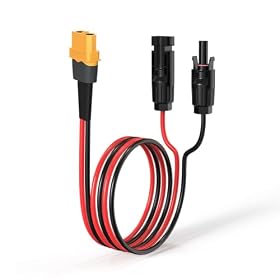
Portable power stations may use different solar-input connectors. Some panels include an adapter, while others require a separately purchased cable. Verify the connector type, polarity, and cable ratings before connecting anything.
Do not force a connector or use a cable with uncertain wiring. If the documentation is unclear, contact the manufacturer or have a qualified person verify the connection.
Consider the station’s maximum charging wattage
A panel rated above the power station’s maximum solar charging wattage will not necessarily make the station charge faster. The station may limit the input, but the panel can still be a poor value if much of its rated capacity cannot be used.
A panel rated below the station’s maximum may charge safely but more slowly. Actual output also varies with sun angle, clouds, temperature, shading, surface orientation, and the panel’s operating conditions.
Does a suitcase perform better in partial shade?
Not automatically. A solar suitcase may have several panel sections, but its performance in shade depends on how the sections are wired and how the power station’s charge controller responds. One shaded section can still reduce the useful output of the entire connected panel arrangement.
The practical advantage is positioning: a suitcase may let you move or angle individual sections more easily to avoid nearby shade. Do not buy one solely on the assumption that its folded design guarantees better shade performance.
For either style, keep the active surface clear of leaves, dirt, branches, and other obstructions. Even a narrow shadow across part of a panel can reduce output noticeably.
Which is easier to use during an outage?
For outage preparation, a solar suitcase is often easier for a person to deploy quickly because it can be opened, aimed, and packed away without much additional equipment. This is useful when the panel must be moved as the sun changes or brought indoors during bad weather.
A large foldable panel can work well if it will remain in one secure location and storage space is limited. Make sure the setup does not block walkways, create a trip hazard, or expose the panel and cables to rain beyond their stated protection rating.
Neither panel should be treated as a guaranteed refrigerator backup by itself. A fridge’s starting surge, running behavior, ambient temperature, and duty cycle all affect how long a power station can operate it. Size the power station and solar input separately from the panel’s physical format.
Which should you buy?
Choose a solar suitcase if you prioritize:
Fast setup with less supporting equipment
Easy angle adjustment
Frequent repositioning at a campsite or outage location
Choose a single large foldable panel if you prioritize:
Flat storage in a vehicle or small space
A lightweight or low-profile setup
Placement on a stable surface where a stand is not essential
Simple deployment in an open, mostly shade-free area
If the two options have similar rated wattage, the decision usually comes down to physical handling and support. If their wattages differ, first verify that the larger panel does not exceed the portable power station’s solar-input voltage, current, or wattage limits.
Before connecting the panel
Read the power station’s solar-input voltage, current, wattage, and connector requirements.
Compare those limits with the panel’s operating voltage, open-circuit voltage, current, and rated wattage.
Check whether an adapter or extension cable is required and verify its polarity.
Unfold the panel completely and place it on a stable surface with clear airflow.
Keep cables away from water, sharp edges, vehicle tires, and walking paths.
Connect the panel according to the manufacturer’s instructions and confirm that charging begins.
Disconnect before moving the panel or changing the wiring.
Solar panels can produce power whenever they receive light. Do not leave exposed connectors touching conductive surfaces, and follow the manufacturer’s instructions for rain, wind, storage, and cleaning.
FAQ
Is a solar suitcase better than a large foldable solar panel?
Neither is universally better. A solar suitcase is usually easier to angle, carry, and deploy, while a single large foldable panel may store more easily in a narrow space. Choose based on the setup location, support requirements, and compatibility with your power station.
Can any solar suitcase charge a portable power station?
No. The panel must match the power station’s solar-input voltage range, maximum current, maximum charging wattage, connector, and polarity requirements. Check both manufacturers’ specifications before connecting it.
Does a larger foldable panel charge faster?
It can, if it receives enough sunlight and the power station can accept its output. A panel rated above the station’s solar-input limit may be capped, and real-world output is reduced by shade, clouds, poor angle, dirt, and heat.
Can I connect two foldable solar panels to one power station?
Only if the power station supports that arrangement and the combined voltage and current remain within its input limits. Follow the manufacturer’s wiring instructions, and do not connect panels in series or parallel based only on matching connectors.
Can I leave a foldable solar panel outside in the rain?
Only if the panel and all exposed connections are specifically rated for those conditions. Check the manufacturer’s weather-resistance instructions, keep connectors off wet ground, and bring the equipment inside during severe weather unless approved for it.