Adding an extra battery is not automatically cheaper than buying a larger portable power station. The better value depends on the battery capacity you need, whether your current unit supports expansion, and whether you need more runtime or more AC output. Expansion batteries usually increase stored energy, while a larger base unit may also provide a stronger inverter, faster charging, more ports, and better long-term flexibility.
Wh & Watts · Mon Sep 07
Cost of Extra Batteries Versus a Larger Base Unit
An expansion battery can add runtime without replacing your power station, but a larger base unit may offer more inverter output, ports, and simpler setup. Compare the total cost and practical tradeoffs before buying.
Compare the total system cost
Start with the cost of the complete setup, not just the advertised battery capacity.
Expansion-battery system
Add together:
- Your existing power station
- The compatible expansion battery or batteries
- Any required battery cable, hub, or adapter
- A compatible solar panel or car-charging setup, if needed
- Shipping, if applicable
This option can be financially sensible when you already own a capable power station and only need more runtime.
Larger-base-unit system
Compare that total with:
- A larger power station
- Any required charging accessories
- The value of your existing unit if you can sell or repurpose it
- The cost of replacing accessories that are not compatible with the new model
A larger base unit may have a higher purchase price but can be more economical if it replaces several add-ons or provides features you would otherwise need later.
Compatible expansion battery
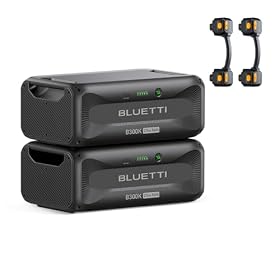 BLUETTI Expansion Battery B300K×2, 5529.6Wh Battery Pack for Apex 300BLUETTI
$2,400.99 as of
View on Amazon Compatible with Anker Portable Power Station Expansion AdapterGeneric
$25.50 as of
View on Amazon Ecarke 550W Portable Power Inverter Compatible with Makita 18V Battery, DC 18V to AC 110V…Ecarke
$99.99 as of
View on Amazon
Product prices and availability are accurate as of the date/time indicated and are subject to change. Any price and availability information displayed on Amazon.com at the time of purchase will apply to the purchase of this product.
Capacity is only one part of the comparison
Battery capacity is commonly listed in watt-hours, or Wh. A higher Wh rating generally means more stored energy, but usable runtime is lower than the nameplate capacity because of inverter losses, battery-management limits, and the power draw of the connected device.
A rough planning formula is:
Estimated runtime in hours = battery capacity in Wh × 0.8 ÷ device power in watts
The 0.8 factor is only a planning estimate. Actual results vary by model, load, temperature, battery condition, and whether the load uses AC or DC power.
For example, an expansion battery may give a compatible system substantially more runtime for a refrigerator, CPAP machine, lights, or networking equipment. It will not necessarily make the system better at starting or continuously powering a high-demand appliance.
Larger replacement power station
 Anker 521 Portable Power Station Upgraded with LiFePO4 Battery, 256Wh 6-Port Powerhouse, 300W (Peak 600W)…Anker
$259.99 as of
View on Amazon Panasonic K-KJ17KHC82A eneloop pro High Capacity Power Pack, 8AA, 2AAA, with Advanced Individual Battery Charger…Eneloop
$61.38 as of
View on Amazon Renogy 100W Portable Solar Panel, 25% High Efficiency Solar Panel Kit with 20A Charger Controller…Renogy
$229.30 as of
View on Amazon
Product prices and availability are accurate as of the date/time indicated and are subject to change. Any price and availability information displayed on Amazon.com at the time of purchase will apply to the purchase of this product.
An extra battery usually does not increase inverter output
This is the most important distinction.
If your existing power station has a continuous AC output limit, adding an expansion battery generally does not raise that limit. The system may run a 100-watt load for much longer, but it may still be unable to run a device that requires more than the inverter can provide.
Check these specifications separately:
- Battery capacity: measured in Wh; affects runtime
- Continuous AC output: measured in watts; affects the loads the inverter can run continuously
- Surge output: a short-term peak used during motor or compressor startup
- Port limits: the maximum output available from individual USB, DC, or AC ports
- Input charging rate: affects how quickly the larger battery bank can be recharged
Choose extra battery capacity when your current unit already handles the appliance's startup and running demands. Consider a larger base unit when you need more watts, more outlets, a higher surge rating, or a different port mix.
Solar charging upgrade
- Renogy 100W Portable Solar Panel, 25% High Efficiency Solar Panel Kit with 20A Charger Controller…Renogy
$229.30 as of
View on Amazon  Renogy 100W 12V Solar Panel Starter Kit with 30A PWM ControllerRenogy
$153.99 as of
View on Amazon Solar Power Panel Charging DC USB LED Light Lamp Fan Kit for Home Outdoor Camping
$707.30 as of
View on Amazon
Product prices and availability are accurate as of the date/time indicated and are subject to change. Any price and availability information displayed on Amazon.com at the time of purchase will apply to the purchase of this product.
Check compatibility before comparing prices
Expansion batteries are not universal. They are normally designed for a particular power-station series, connector type, voltage range, and firmware or battery-management system.
Before buying, verify:
- The exact power-station model supports expansion.
- The battery is approved for that model or series.
- The system supports the number of batteries you plan to add.
- The connection cable or hub is included or available separately.
- The combined capacity and charging method match the manufacturer's specifications.
- The warranty remains valid when the expansion battery is installed.
Do not connect a generic battery to a power station unless the manufacturer specifically supports that setup. Incorrect voltage, connector wiring, or charging behavior can damage equipment and create a fire or shock hazard.
When extra batteries are usually the better value
An expansion battery tends to make more sense when:
- You already own a newer power station that meets your output needs.
- Your main problem is runtime during a long outage or trip.
- You want to preserve your existing accessories and charging setup.
- The battery can remain at home rather than being carried with the base unit.
- You need a modular system that can be expanded gradually.
- The expansion battery costs materially less than replacing the entire system after considering required accessories.
This approach can also let you keep one battery system in a fixed location while using the base unit separately, but only if the manufacturer allows that arrangement and explains how the units operate when disconnected.
When a larger base unit is usually the better value
A larger base unit is often preferable when:
- Your current inverter cannot run the intended appliance.
- You need higher motor-starting or compressor-starting capability.
- You want more AC, USB, or DC ports.
- Your current unit has an aging battery or limited charging speed.
- The expansion battery requires expensive cables, hubs, or other accessories.
- You need a simpler one-piece setup for camping or emergency storage.
- The larger unit offers newer charging, display, safety, or connectivity features.
A larger base unit may also be easier to transport than a base unit plus one or more separate batteries, although the larger model can be heavier by itself. Compare the complete packed weight and handle design rather than capacity alone.
Consider charging time and solar limits
Adding battery capacity does not necessarily make recharging faster. In many systems, the same solar or AC input limit is shared across the larger battery bank. If the input is unchanged, a higher-capacity system may take longer to refill from empty.
Check:
- Maximum AC charging input
- Maximum solar input in watts and voltage range
- Whether solar input is shared across connected batteries
- Whether the expansion battery has its own charging input
- Whether car charging is practical for the total capacity
For outage use, charging speed can matter as much as capacity. A system that stores more energy but cannot recover quickly during a short grid-restoration window may be less useful than a smaller system with faster input charging.
Account for battery age and warranty
An expansion battery purchased years after the base unit may have a different age, warranty period, or firmware requirement. Battery systems may also limit performance when connected batteries have significantly different states of charge or conditions.
Follow the manufacturer's guidance on:
- Initial charging and balancing
- Storage charge level
- Operating temperature
- Firmware updates
- Mixing battery revisions
- Using batteries from different production periods
If the existing base unit is already near the end of its expected service life, putting money into a matching expansion battery may provide less value than replacing the whole system.
A simple break-even method
Use this comparison before shopping:
- Write down the usable capacity and continuous output of your current unit.
- Identify the minimum capacity and output your loads require.
- Confirm the exact compatible expansion batteries and required accessories.
- Calculate the complete expansion-system cost.
- Compare it with a larger base unit that meets the same capacity and output targets.
- Add the value of portability, charging speed, warranty coverage, and resale or repurposing options.
Do not compare only dollars per advertised watt-hour. A lower-capacity system with insufficient inverter output is not a substitute for a higher-output unit, and a high-capacity system with slow charging may not meet your outage needs.
Bottom line
Choose an extra battery when your current power station has enough inverter output and ports, but you need longer runtime. Choose a larger base unit when you need more wattage, better surge performance, faster charging, additional ports, or a simpler all-in-one setup. Confirm compatibility and calculate the complete system cost before treating an expansion battery as the cheaper option.
FAQ
Is an expansion battery cheaper than buying a larger power station?
It can be, especially when your existing power station already has enough inverter output and you only need longer runtime. Compare the battery, cables, hubs, and other required accessories with the complete cost of a larger base unit.
Does adding an expansion battery increase watt output?
Usually not. An expansion battery generally increases stored energy and runtime, while the base unit's continuous AC output and surge rating remain the limiting factors. Check the manufacturer's specifications for the specific system.
Can I use any expansion battery with a portable power station?
No. Expansion batteries are normally model- or series-specific. Use only batteries, cables, and hubs approved by the power-station manufacturer.
Will an extra battery charge as quickly as the base unit?
Not necessarily. The system may retain the same AC, solar, or car-charging input limit while the total battery capacity increases, which can make a full recharge take longer.
When should I replace the whole power station instead?
Consider a larger base unit when the current inverter cannot run your appliances, the battery is aging, you need more ports or faster charging, or compatible expansion accessories make the modular system too costly or complicated.