Buying Anderson adapters before the first sunny day
The right Anderson adapter depends on more than whether the plug fits. Match the connector family, polarity, wire size, voltage, current rating, and the solar input limits of your portable power station before connecting a panel.
Buying Anderson adapters before the first sunny day
An Anderson adapter can connect a solar panel, charge controller, battery, or portable power station—but only when its connector, polarity, wiring, and electrical ratings match the equipment. A plug that physically fits can still be wired incorrectly or exceed the input limits of the power station.
Before buying, identify the connector on both devices, confirm the power station’s solar-input specifications, and choose an adapter made for the panel’s expected voltage and current. Do not connect a panel directly if the power station requires a charge controller or a specific adapter arrangement.
What an Anderson adapter does
“Anderson adapter” usually describes a cable or connector assembly using an Anderson-style high-current connector on one end and another connector on the other. Depending on the cable, the other end may be:
The connector family matters. Anderson Powerpole connectors and larger Anderson SB-style connectors are not automatically interchangeable, even if both are sold as Anderson connectors. Housing size, contact size, gender configuration, and current rating all need to match.
Check these specifications before ordering
1. Identify the connector type and size
Look at the solar panel cable and the power station’s solar input. Confirm:
The connector family or model series
Contact size and housing size
Whether the connector is keyed or genderless
The plug’s locking or retaining method
Whether the cable needs one connector or a complete adapter assembly
Some portable power stations use a proprietary Anderson-style input, while others use an Anderson connector only on an adapter cable. The product listing and power station manual should identify the required connector or compatible cable.
Do not rely on a listing that only says “Anderson compatible.” Compare clear photos, dimensions, connector markings, and the manufacturer’s compatibility information.
2. Verify polarity
Polarity is one of the most important checks. The adapter must deliver positive and negative connections to the correct terminals. Anderson-style connectors can sometimes be assembled with the contacts arranged differently, so two plugs may look compatible but be wired oppositely.
Use the polarity diagram in the power station manual and the markings on the panel or adapter. If the cable has no polarity information, do not guess. A multimeter can help identify positive and negative conductors, but anyone unfamiliar with electrical testing should follow the manufacturer’s instructions or ask a qualified technician.
3. Match voltage and current limits
The power station’s solar input normally specifies a permitted voltage range and a maximum charging current or wattage. The panel’s open-circuit voltage, commonly labeled Voc, can be higher than its operating voltage, so compare the panel’s Voc—not only its nominal voltage—with the power station’s maximum solar-input voltage.
Also check the panel’s short-circuit current, or Isc, and operating current against the input limit. Series-connected panels increase voltage; parallel-connected panels increase current. Either arrangement can exceed the power station’s limits if it is not specifically supported.
An adapter does not regulate power. If the panel voltage is too high, changing the connector will not make it safe. Use the charging arrangement specified by the power station manufacturer.
4. Choose suitable wire and connector ratings
A short, properly sized cable generally wastes less energy than a thin or excessively long cable. The cable should be rated for the expected current, outdoor conditions, and the connector contacts being used.
For portable solar setups, look for:
Cable conductors sized for the maximum current
Insulation suitable for outdoor or photovoltaic use when exposed outside
Securely crimped or molded connectors
A current rating equal to or greater than the intended application
Strain relief at each connector
A high-current connector does not make an undersized cable suitable. The cable, terminals, fuse, and equipment input should all be considered together.
Product prices and availability are accurate as of the date/time indicated and are subject to change. Any price and availability information displayed on Amazon.com at the time of purchase will apply to the purchase of this product.
Common adapter configurations
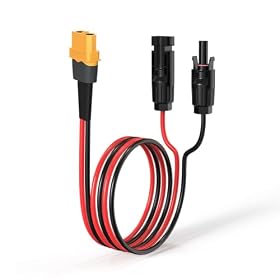
MC4-to-Anderson cable
This is useful when a solar panel has MC4 output connectors and the power station accepts an Anderson-style solar input. Check whether the cable uses the correct MC4 polarity and whether the Anderson end matches the power station’s input.
MC4 connectors are often gender-specific and should not be forced together or mixed with incompatible lookalike connectors. Keep unused connectors capped and dry.
Anderson-to-DC barrel adapter
Some power stations accept a barrel-style DC input rather than an Anderson connector. Match the barrel’s outer diameter, inner diameter, voltage rating, polarity, and maximum current. A barrel plug that fits loosely can heat up or lose contact under load.
Anderson-to-Anderson extension
An extension may help place the panel in better sunlight while the power station remains in a shaded, ventilated location. Account for voltage drop over the added cable length and protect the connection from water, dirt, and accidental strain.
Adapter for a charge controller
A panel connected to a battery may require a solar charge controller. A portable power station generally has its own charging electronics, so adding another controller may be incompatible unless the manufacturer explicitly permits it. Do not bypass required charge-control equipment.
Product prices and availability are accurate as of the date/time indicated and are subject to change. Any price and availability information displayed on Amazon.com at the time of purchase will apply to the purchase of this product.
Safety checks before the first connection
Read the power station’s solar-input limits and connector requirements.
Check the panel’s Voc, operating voltage, Isc, and operating current.
Confirm connector type, polarity, and cable orientation.
Inspect the cable for damaged insulation, loose terminals, bent contacts, or signs of overheating.
Connect with the panel out of direct sun when practical, or follow the equipment instructions for connection order.
Keep connectors clean, dry, and fully seated.
Place the power station where it has adequate ventilation and protection from rain.
Monitor the first charging session for unexpected heat, intermittent charging, or error messages.
Disconnect the panel before changing wiring or rearranging panels. Do not connect or disconnect damaged connectors, and do not work on energized outdoor wiring during wet conditions.
Troubleshooting an adapter that does not charge
The plug does not fit
Stop rather than forcing it. Recheck the connector family, contact size, and power station input. A physically similar connector may not be compatible. The reasonable next step is usually the manufacturer’s specified cable or a verified replacement adapter, not a filing, cutting, or improvised splice.
The power station shows no solar input
Check polarity, connector seating, panel exposure, and the power station’s charging mode. If the panel has a detachable cable, inspect each connection. Some systems need a minimum input voltage before charging begins, especially in weak or filtered sunlight.
Charging starts and stops
Possible causes include a loose connector, shading, excessive cable voltage drop, an input overcurrent or overvoltage condition, or the power station reaching a charge limit. Disconnect and review the panel and input specifications before trying again. If the cable or connector becomes warm, stop using it.
The adapter or connector gets hot
Unplug the system when safe and inspect for an undersized cable, loose crimp, damaged contact, corrosion, or a poor-fitting plug. Heat is not a normal substitute for a current rating. Replace the affected cable or connector assembly; do not continue using a visibly damaged or overheated part.
The setup worked with one panel but not two
Adding panels can raise voltage or current beyond the power station’s limits. Recalculate the series and parallel values and compare them with the manufacturer’s maximums. Use only a supported panel configuration.
When to buy an adapter—and when not to
Buy an adapter when the manufacturer documents the connection, the electrical limits are compatible, and the cable has the correct polarity and ratings. A complete, correctly terminated cable is generally preferable to an adapter assembled from several unknown parts.
Do not buy based only on connector appearance or a claim that the cable is “universal.” If the power station’s input specification is unclear, contact the manufacturer before connecting a solar panel. Replace the adapter or cable if it has damaged insulation, loose contacts, corrosion, heat damage, or unexplained charging interruptions.
FAQ
Can I use any Anderson adapter with a portable power station?
No. Anderson-style connectors vary by family, housing, contact size, polarity, and current rating. The adapter must match the power station’s specified input cable and electrical limits.
What should I check on a solar panel before connecting it?
Check the panel’s open-circuit voltage, operating voltage, short-circuit current, operating current, connector type, and polarity. Compare those values with the power station’s maximum solar-input voltage, current, and wattage.
Can an Anderson adapter increase a power station’s solar input?
No. An adapter changes the physical connection; it does not regulate voltage, increase the input limit, or make an incompatible panel safe.
Is an MC4-to-Anderson cable always compatible with a power station?
No. The MC4 end may fit the panel while the Anderson end has the wrong size or polarity for the power station. Confirm the complete cable specification and the power station manufacturer’s requirements.