A 200W panel kit with a portable power station can mean two different purchases: a solar panel kit added to a station you already own, or a package that includes both the 200W panels and the power station. The total cost depends mainly on the station’s battery capacity and solar-input limits, not just the panel’s 200W rating. Before comparing prices, confirm what is included and whether the panel can safely charge the station.
Solar · Mon Sep 07
Cost of a 200W panel kit with the station
The cost of a 200W solar panel kit with a portable power station depends on whether the station is included, the battery capacity, panel type, charge controller, cables, and brand. Use this guide to compare complete packages without paying for incompatible accessories.
What do you need help with?
Open an answer, or tell us what we should cover next.
Answered in this guide
Compare the cost of a complete 200W solar package
Compare a bundle with separate purchases by checking what the price includes, including the station, panels, controller, cables, adapters, and other accessories. This helps reveal whether a package is genuinely cheaper or simply leaves out necessary parts.
Understand what makes a 200W kit cost more
The power station is usually the largest cost factor. Larger batteries, stronger inverters, more ports, and faster charging raise the price, while panel construction and the number of panels also affect the package cost.
Compare folding and rigid 200W solar panels
Folding panels are convenient for camping and storage, while rigid panels can offer a lower-cost or more permanent setup. A 200W kit may also use two smaller panels connected together, affecting both price and convenience.
Check whether a 200W kit fits your power needs
A 200W array can help extend off-grid runtime or recharge a station during the day, but it does not ensure that the station can continuously run a high-demand appliance. Suitability depends on your loads and usage pattern.
Check that the panels and station are compatible
Before buying, confirm that the panel voltage, current, input range, and connector match the station. Do not connect panels in series or parallel unless the resulting electrical values stay within the manufacturer’s limits.
Need something else?
Request a topic and help us choose what to build next.
Calculate how long a 200W setup will recharge your station
Choose the right solar cable or adapter for your station
Diagnose a solar panel that is not charging the station
Choose a power station for panels you already ownRead this guide →
Requests help us prioritize the next guide. No email required.
One anonymous request per topic.
What the total cost usually includes
A complete setup may contain some or all of these items:
- Portable power station
- One or more solar panels totaling about 200W
- Built-in or separate charge controller
- Solar charging cable or adapter
- Extension cable
- Carrying case or panel storage bag
- Extra battery, if additional runtime is needed
A listing described as a “200W panel kit” may include only the panels and cable. A listing described as a “power station and 200W solar panel bundle” should include the station, but check the package contents rather than relying on the title.
Compatible 200W solar charging kit
 Renogy 100W Portable Solar Panel, 25% High Efficiency Solar Panel Kit with 20A Charger Controller…Renogy
$229.30 as of
View on Amazon Renogy 100W 12V Solar Panel Starter Kit with 30A PWM ControllerRenogy
$153.99 as of
View on Amazon SerenelifeHome Serenelife 200 Watt Portable Solar Panel Kit, Foldable Monocrystalline Briefcase Set with 20A PWM…SereneLife
$195.33 as of
View on Amazon
Product prices and availability are accurate as of the date/time indicated and are subject to change. Any price and availability information displayed on Amazon.com at the time of purchase will apply to the purchase of this product.
The biggest cost factor: the power station
Power stations with larger batteries, higher inverter output, more ports, and faster charging generally cost more than small units. A 200W solar array may be appropriate for a compact station, but it can also be paired with a larger station if the station accepts that solar input.
Check these specifications before comparing packages:
- Battery capacity: Listed in watt-hours (Wh). More Wh means more stored energy, but it also generally takes longer to recharge from a 200W array.
- Solar input limit: The station may accept less than 200W, approximately 200W, or more than 200W. Never exceed the manufacturer’s voltage, current, or wattage limits.
- Input connector: The panel cable must match the station’s solar input or use a manufacturer-approved adapter.
- Inverter output: This affects what you can run from the station, but it does not increase how quickly the solar panels recharge it.
- Battery chemistry: Battery type can affect weight, usable capacity, cycle life, and the purchase price.
A larger station is not automatically a better value if you only need to recharge small electronics. Conversely, a lower-cost station may be a poor choice for outage use if it cannot run the devices you need or accept the full solar input.
Solar charging cable or adapter
 ELFCULB 10AWG 35FT XT60 Solar Cable 2 10 25 35 50 75 100FT XT60 Extension…ELFCULB
$58.88 as of
View on Amazon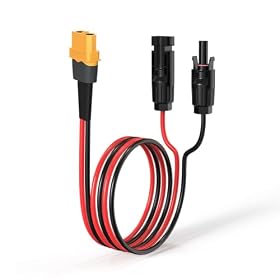 ELFCULB 10AWG 6FT XT60 Solar Cable 2 6 10 25 35 50 75 100FT XT60…ELFCULB
$18.88 as of
View on Amazon WITOMAERN 16.5FT 14AWG+16AWG Solar Cable with Solar Panel Connector to DC7909+8020 Compatible with Anker 521…WITOMAERN
$20.00 as of
View on Amazon
Product prices and availability are accurate as of the date/time indicated and are subject to change. Any price and availability information displayed on Amazon.com at the time of purchase will apply to the purchase of this product.
Panel type affects the price and convenience
A 200W kit may use a rigid panel, folding portable panels, or multiple smaller panels connected together.
Folding portable panels
Folding panels are convenient for camping and temporary outage use. They usually store more easily, but hinges, fabric, kickstands, and cable connections add parts that can wear or be damaged.
Rigid panels
Rigid panels are often intended for more permanent outdoor mounting. They can be practical for a cabin, shed, or dedicated backup setup, but mounting hardware and weatherproof cable routing may be separate costs.
Two-panel kits
Some kits reach approximately 200W by combining two panels. This can make placement easier when part of the array is shaded, but the connection method matters. Follow the power station and panel manufacturer’s instructions for series or parallel wiring.
Portable power station for a 200W solar input
- Renogy 100W Portable Solar Panel, 25% High Efficiency Solar Panel Kit with 20A Charger Controller…Renogy
$229.30 as of
View on Amazon  Real 200W Power Inverter Compatible with Milwaukee 18V, VoLtTech Battery Inverter 18V to 110V-120V, Phone…VoLtTech
$25.99 as of
View on Amazon
Product prices and availability are accurate as of the date/time indicated and are subject to change. Any price and availability information displayed on Amazon.com at the time of purchase will apply to the purchase of this product.
Why the advertised 200W may not be the charging speed
The 200W figure is a rated maximum under specified conditions. Actual solar input changes with sunlight angle, clouds, heat, shading, panel orientation, and cable losses.
The power station may also limit charging even when the panel kit is rated at 200W. For example, if the station’s solar input limit is lower than the panel array’s rating, the station will not use the full potential output. If the station accepts more than 200W, a 200W kit still may not reach the station’s maximum input.
Treat the rated wattage as a sizing figure, not a guaranteed continuous charging rate.
How to compare package prices fairly
Use this checklist when comparing a bundle with separate purchases:
- Write down the power station’s battery capacity and solar-input specifications.
- Confirm whether the package includes one 200W panel, multiple panels, or a panel rated for a maximum output near 200W.
- Check whether the solar cable is included.
- Confirm that the connector and electrical limits are compatible.
- Add any required extension cable, adapter, mounting hardware, or storage case.
- Compare warranty coverage for the station and panels separately.
- Check shipping, taxes, and any bundle-only accessories before deciding.
The cheapest advertised package may not be the lowest total cost if it requires a proprietary cable, an adapter, or replacement mounting hardware.
Is a 200W kit enough for your use?
A 200W array is mainly useful for extending off-grid runtime or recharging a station during the day. It is not a guarantee that a station can run a high-demand appliance continuously.
For camping, a 200W kit may help recharge a station used for phones, lights, cameras, small electronics, and selected low-power appliances. For outages, check the refrigerator’s starting and running power separately. A station must support the refrigerator’s startup demand, while the battery must hold enough energy for the desired runtime.
For a rough planning estimate:
Approximate solar energy per day = panel rating × usable sunlight hours × system efficiency
The result is only an estimate. Weather, shade, panel angle, temperature, and charging limits can reduce the actual amount stored in the station.
When a separate panel purchase makes sense
Buy a panel kit separately when you already own a compatible station, want to choose a particular panel format, or need to replace a damaged panel. This can also be useful when a station bundle includes a panel that is too small for your planned use.
A bundle may be more convenient when the cable, connectors, and panel are confirmed to work with the station. It can also reduce the risk of ordering a panel with the wrong voltage range or connector.
Safety and compatibility checks
Use only the input range and connection methods specified by the power station manufacturer. Do not connect panels in series or parallel unless the resulting voltage and current stay within the station’s limits. Keep connectors dry, inspect cables for damage, and avoid using damaged panels or adapters.
For a permanent installation, exposed outdoor wiring, or a setup connected to household circuits, follow local electrical requirements and consult a qualified professional. A portable power station should not be connected to home wiring through an ordinary outlet; use an approved transfer setup installed according to applicable requirements.
Bottom line
The cost of a 200W panel kit with a portable power station is determined by the complete system: station capacity, inverter output, solar-input limits, panel construction, cables, adapters, and warranty. Compare the total compatible package rather than the panel’s wattage alone. If you already have a station, verify its solar-input specifications first; if you are buying a bundle, confirm that the station, panels, and charging cable are all included.
FAQ
Does a 200W solar panel kit include the power station?
Not always. A 200W panel kit may include only the panel or panels and a charging cable. A bundle labeled as a power station and 200W solar panel package should include both, but verify the itemized contents before buying.
How much power can a 200W solar panel actually produce?
The 200W rating is a maximum under specified conditions. Actual output varies with sunlight, shading, panel angle, temperature, and cable losses, and the power station may limit how much it accepts.
Can any 200W solar panel charge any portable power station?
No. The panel’s voltage, current, connector, and wiring configuration must be compatible with the station’s solar-input limits. Follow the manufacturer’s specifications and do not exceed them.
Is a 200W panel enough to run a refrigerator?
The panel alone does not determine that. You also need a power station with enough inverter capacity for the refrigerator’s startup demand and enough battery capacity for the desired runtime. Solar conditions determine how quickly the battery can be replenished.
Is it cheaper to buy the panel and power station separately?
It can be, but the comparison should include cables, adapters, shipping, mounting hardware, and warranty coverage. A bundle may cost more upfront while reducing compatibility risks and missing-accessory costs.